Mr. Magoo's Christmas Carol

A blog dedicated to the making of the first animated Christmas special, Mr. Magoo's Christmas Carol.
Showing posts with label Jay Ward. Show all posts

Wednesday, March 16, 2016

Rocky & Bullwinkle in Mexico

Frank Hursh, head of background dept at Gamma
If you grew up with Mr. Magoo's Christmas Carol, it's a good bet you watched Rocky &
Bullwinkle and all the rest of Jay Ward's series.  For the next few weeks, my Jay Ward blog takes you behind the scenes at the Mexican studio, Gamma Productions, that actually produced those series.  This week, meet the ex-pat American head of the background department, Frank Hursh, and in the ensuing posts see some more rare photos and art from that era. Take a gander here.  And if you need a guidebook for your tour, get one here.

Thursday, December 10, 2015

What's new on the Jay Ward blog


This has nothing whatsoever to do with Mr. Magoo or Christmas but if you're a fan of Jay Ward you might want to check out the latest post at artofjayward.blogspot.com where I show very rare images from the original Dudley Do-right pilot produced in 1948, 13 years before he first appeared on The Bullwinkle Show.  The above image is NOT from the pilot but drawn by UPA and Ward director, Pete Burness. 

Wednesday, October 14, 2015

Activities on the Art of Jay Ward blog

As you may have noticed, updates on this blog are few and far between.  As new information or artwork comes in, I will post on this blog but in the meantime, check out my sister blog, artofjayward.blogspot.com where I continue to post new info and art on the Jay Ward studio.  Lately, I've been posting regularly on Bill Scott's gag cartoons on life at Ward's and will continue to do so for the next few weeks.  Bill Scott, Jay's partner and head writer, producer and all around voice artist (Bullwinkle, Dudley Do-right, Super Chicken, George of the Jungle, etc) came up through the animation ranks and, as a cartoonist armed with biting wit, made humorous observations on their difficulties with ad agencies, networks, their status in the industry, and even each other.

This week, a series on ad agency shenanigans:


Check out this and previous postings at artofjayward.blogspot.com.  And if you haven't bought the book, The Art of Jay Ward Productions, a limited number of copies are available HERE for half off the cover price of $49.95.  For those of you without calculators, that means just $25.  Christmas is coming, I'm just saying...

Wednesday, August 19, 2015

Gerard Baldwin, a life in animation


Readers of either of my books, Mr. Magoo's Christmas Carol, The Making of the First Animated Christmas Special or The Art of Jay Ward Productions will instantly recognize the name Gerard Baldwin.  Baldwin was responsible for directing and animating the highly memorable, show-stopping sequence featuring the Despicables in Christmas Carol.   For Jay Ward, he directed and animated many of the best episodes of Fractured Fairy Tales, Aesop & Son and Dudley Do-right at Jay Ward as well as animating several pilots such as Hoppity Hooper, Super Chicken and George of the Jungle.  Baldwin had a flair for turning the limitations of low-budget animation into assets while squeezing out the highest possible entertainment value.


Now, you can learn a little bit more about the master himself in his new book, From Mister Magoo to Papa Smurf, A Memoir by Gerard Baldwin, available at Amazon and Barnes & Noble.  Beginning at his beginning, Baldwin recounts growing up in New York, his decision to become an artist and his sideways move into the medium that would define his career, animation.  You'll read about his early days as an inbetweener at UPA, his military service, his return to UPA and his rise as an animator and director in the TV animation industry, culminating in becoming a producer on Hanna-Barbera's The Smurfs.  Between his stories from the animation trenches and his wry observations, there are a number of charming drawings illustrating anecdotes from his life.


During it's baby boomer heyday, television animation was usually looked down upon, especially by those in the industry.  Consequently, very few animators and directors from that era put their experiences and thoughts down on paper; this is rare insight into the art and commerce of 1960s animated cartoons that is of interest to not only those that grew up with the cartoons but for anyone who follows pop culture.  You can buy it here.

Thursday, March 12, 2015

Sam Clayberger, designer at UPA

Sam Clayberger painting at UPA
I first met designer and painter Sam Clayberger as part of my research for my book, The Art of Jay Ward Productions.  As it eventually turned out, Sam became quite a resource for art for that book, having been Ward's principal background painter for most of the Ward studio's history.

Readers of my book may recall that most of Jay Ward's staff came from UPA after having left the studio as it was collapsing in 1959.  While many of the directors at Ward were already old pros by the time they arrived at UPA, most of what would become the design crew at Jay Ward Productions were recent grads of the LA art schools.  A prime example of that was Sam Clayberger who, sometime after graduating from Chouinard Art Institute, got a phone call from Chouinard instructor Don Graham informing him of a short term  opportunity at UPA moving desks.  Sam took the gig and parlayed that "quickie" into a full time job doing layout and later background painting.  He left employment at UPA after a few years in order to paint but kept money coming in as a freelancer first at Hanna-Barbera in their early days and later working for Ward as a full-time freelancer so he could continue to paint, later adding teaching at Otis Art Institute into his already full schedule.

Sam recently came across a small stack of his color thumbnails from his brief time at UPA where he worked on a number of Mr. Magoo cartoons, some of which are reproduced here for your enjoyment.  First up, Magoo's Cruise from 1958, in which Magoo arrives on a pier for a reunion cruise with old friends but is mistakenly taken on board what appears to be a Soviet submarine. Sam is credited with design and color, which would mean he designed and laid out the backgrounds as well as keying and painting them.  (Brief footnote here, one of the animators on each of the shorts listed here was Casey Onaitis, who animated on Mr. Magoo's Christmas Carol.)  The last image is an actual production background of the interior of the submarine.


Next, 1957's Magoo's Private War, in which he is credited for design (layout) and co-credited with Ervin Kaplan for color.  The color styling was all Sam's making it likely that Erv followed up on the backgrounds.  In the cartoon, Magoo mistakes a theatrical war film for an invasion and tries to calm the audience, telling them that "General Clayberger" will be coming to save them.  Most of the beginning shots are painted quite hot in contrast to the bulk of the film which takes place in either a darkened theater or on nighttime city streets.  The currently available transfer of this film is on the murky side in comparison to these color keys.


Finally, Merry Minstrel Magoo from 1958 wherein Magoo heads down to a TV station to audition for a talent show; Sam is credited with both design (layout) and color:


Unfortunately, these cartoons are not available online so if you'd like to see them to compare them to Sam's originals, you'll have to pick up the boxed set from The Shout Factory which is available here on Amazon.  Up next will be some of Sam's keys for black & white UPA commercials.  On March 23rd, be sure to check out my Jay Ward blog here for some examples of Sam's beautiful color keys for Jay Ward.

Monday, September 8, 2014

Where have I been?

Marketing, promoting and selling The Art of Jay Ward Productions, that's where!  Most of the spring and early summer was spent making the rounds of the various LA animation studios with Ward artist Sam Clayberger in tow as well as several book signings with June Foray. 

June Foray at the Larry Edmunds Bookshop in Hollywood


We even had an evening at the Aero Theater in Santa Monica with Sam and Allan Burns, whom you may remember as the co-creator and co-producer on The Mary Tyler Moore Show.  For those who haven't read the book, Allan's writing career really got started at Jay Ward before he moved into live action comedy writing.

Sam Clayberger and Allan Burns at the Aero Theater
If you haven't yet purchased a copy of The Art of Jay Ward Productions and would like to, I have a limited number of artist signed copies.  These are signed by the aforementioned Sam Clayberger and Art Diamond, who has declined to make public appearances at signings so his signature on the books is very rare.  You can buy them here.

And for those who've wondered what happened to my Mr. Magoo's Christmas Carol posts, I stopped because there didn't seem to be any more to say.  However, a few weeks ago, some very interesting material surfaced, material that I wish I had had for the 50th anniversary of the book, which you can still buy here for a limited time.  Stay tuned for an upcoming post revealing just what was discovered.

Tuesday, November 19, 2013

IT'S HERE!!!!!

At long last, The Art of Jay Ward Productions is here!  The book is jammed with art and photos, 980 to be exact, and fills 352 pages.  It's also heavy, weighing in at over 4 lbs!  Some images from inside the book can be seen at the visual essay I composed for Cartoon Brew, check it out here.  You can order it at www.artofjayward.com.

Wednesday, March 13, 2013

Update on "The Art of Jay Ward Productions" book

I thought I would provide just a little update on my next book, "The Art of Jay Ward Productions" for the few followers of this blog.  The book covers the years from 1958 through 1984, and will include pages of artwork from virtually every show the studio produced as well as lots of never-before-seen art from unsold series.  I'm even hopeful that the cereal companies will grant permission to use images from many of the commercials Ward produced for them over the years, but it's been a slow process so far.
     The book's scheduled release has been pushed back from October 2013 to February 2014 in order to coincide with the release of the Dreamworks feature, Mr. Peabody and Sherman.  While it provides me with a little more breathing room, there is still much to be done.  At this point, I anticipate the book having more pages and artwork than even the limited edition of Mr. Magoo's Christmas Carol.
     The manuscript is now complete and has gone through the editorial pass.  I'm about halfway through rough layout, which has been a time-consuming job simply because I've amassed over 4000 images over the last six months, with more pouring in each month.  I'm still on the lookout for original production art featuring Rocky and Bullwinkle, Dudley Do-right and Tom Slick to fill out a few blank spots in the book.  I'm open to any other interesting finds so if anyone out there has Jay Ward art hiding in their collections or knows anyone who collects Ward art, please contact me at your earliest convenience.  Although I have many crew photos, I'm also on the lookout for more, so if you know someone who worked for Ward or if you're a family member of someone who worked there, I'd like to hear from you.  Below is a list of people I need photos for:


Jim Hiltz
Norm Gottfredson 
Gerry Ray
Joe Montell
Frank Hursh
Ellie Bogardus
Bill Littlejohn
Herman Cohen
Art Babbitt
Bob Maxfield
Fred Madison
Frank Smith


Monday, September 10, 2012

The Art of the Jay Ward Studio


If everything falls into place, it appears that the follow up to the making of Mr. Magoo's Christmas Carol book will be a book on the art of the Jay Ward studio.  As I mentioned in the previous book, both UPA and Ward shared a number of key artists throughout the early 60s.  One of those artists, Shirley Silvey, kept a lot of material from her days at both studios and as I began sifting through the material, it occurred to me that there was a book in both her life and work as well as a book on the visual aspect of the one studio, who more than any other, tried to keep 'funny' alive in TV animation.  I proposed the book to Classic Media and the Ward estate, who are tied together as Bullwinkle Studios; both were enthusiastically behind it.

This book won't be a history of the Jay Ward studio, Keith Scott's thorough examination of the Jay Ward studio, The Moose That Roared, has already covered that topic and covered it exceptionally well.  This is meant to be a visual encyclopedia of the art created by some of the industry's most talented designers and boarders within the context of TV animation's 'golden age'.  The reason I'm devoting space to on this blog is that although I've collected a lot of images for this book already, I'm asking any and all collectors of Jay Ward art for scans of their art for use in the book in order  to make it as complete as possible.  This call includes original storyboards, model sheets, layouts, cels, backgrounds, pitch art for unsold pilots, promotional art, ad art, the Bullwinkle comic strip and comics, etc.

I realize that much of the early Ward production work was done in Mexico making it extremely difficult to locate, if in fact it still exists.  However, more often than people realize, episodes, titles and bridges were animated in Hollywood and every so often, an artifact from those productions shows up.  If you're a collector of Jay Ward production art or know someone who is, please have them contact me here.  And if you know family members of artists who worked at Jay Ward, please send them my way.

To be clear, I'm not looking for scene cels, art that was manufactured for the retail market.  It's unclear as to whether or not General Mills or Quaker Oats will cooperate with this venture so for the time being, I'm focusing on the entertainment side of Jay Ward productions rather than their commercial productions like Cap'n Crunch or Quisp and Quake.  The book is scheduled to be published late next year. 

Monday, October 3, 2011

Gerard Baldwin, director

His work may be familiar to audiences everywhere even if his name isn’t.  Readers of my book will remember Gerard Baldwin as the sequence director who conceived and executed the show-stopping number in Mr. Magoo’s Christmas Carol, “We’re Despicable”.  That memorable sequence was but one small moment in a long and varied career in animation.  Baldwin’s development as an animator and director parallels that of television animation; he entered the field during the theatrical era but as the animation business changed, he followed, carving a niche for himself in mid-century pop culture. 

Gerard, a graduate of the Chouinard Art Institute, got his start in animation after being hired by legendary UPA director, John Hubley.  His first work for the studio was in doing the drawings between the animator’s key drawings but his career was sidelined when he was asked to serve in the Korean War.  He returned to UPA in 1952, working under Pete Burness, the director of the Magoo cartoons but left for a better paying job at Ray Patin Productions, an animated TV commercial production house.  He soon bounced back to UPA to work as an assistant with noted animal draftsman and animator, Ken Hultgren, where his job was to “take Hultgren’s anatomically correct and beautiful drawings and…flatten them out and force them into the UPA ‘look’.”   Before long, Hubley approached him about joining Storyboard Films, the company he had founded to produce TV commercials as well as the ill-fated animated feature, Finian’s Rainbow.  While there, he was assigned the task of animating Saul Bass’s graphic titles for The Seven Year Itch but it wasn’t until he joined former UPA director, Ted Parmelee at his outfit, Graphic Films, that he became a full-fledged animator.

Uncle Waldo gets an idea-some of Baldwin's inspired
animation from the Hoppity Hooper pilot,timed to fit
Jay Ward's crazy clock sound effect.  Click to enlarge.
In 1960, yet another UPA director, Bill Hurtz, who was directing for Jay Ward, asked if he would be interested in directing on the series, Rocky and His Friends.  Baldwin, seeing the chance to move from animator to director, agreed and not only directed many episodes for Ward but also animated the titles for Aesop & Son, the titles for Fractured Fairy Tales and most of the pilot film for Hoppity Hooper, with additional contributions by Looney Tunes animator Ben Washam.  Several years later, he animated the first Cap'n Crunch commercial.

While at Ward, Gerard directed and animated entire episodes of Dudley Do-Right that are, without a doubt, the best and funniest of the bunch.  He had a penchant for exceeding the absurdity of the scripts with equal lunacy in his animation approach, due in part to the need to economize because of the low budgets.  Baldwin never let continuity between cuts, the number of fingers or even traditional entrances for characters get in the way of telling his story.  Characters entering a scene will often slide in rather than walk and his poses are concerned more with hammy acting than anatomical or cinematic verity.  Watch The Sawmill episode for all of the above, not to mention perhaps one of the most brilliant three seconds in animation in which Inspector Fenwick and Dudley strive to sort out a miscommunication between the two of them in nothing but multiple cuts of still drawings.


Another episode worth a watch is Marigolds, in which Nell Fenwick has two inventive and funny walks that take full advantage of limited animation(1).  Most who animated under cut-rate budgets settled for mundane execution; Baldwin harnessed the limitations of the medium to his benefit, showing that it was not the tool, but the artist who wielded it, that made the difference.

A sampling of Baldwin's hands from Christmas Carol
During a dry period between gigs for Jay Ward, he received a call from Abe Levitow who needed a sequence done for Mr. Magoo’s Christmas Carol.  Baldwin complied, once again utilizing the low budget as his ally in execution.  Some of the strongest images in the number are the shots when the screen goes black with nothing but mouths singing the chorus.  Between the darkness of the song and Gerard’s inspired execution, it’s probably the most remembered sequence in the film.  Baldwin's work is identifiable by his expressive drawing of hands, usually with four fingers rather than the customary three, a characteristic much in evidence throughout “We’re Despicable”.

Levitow next asked Baldwin to assist with The Famous Adventures of Mr. Magoo.  He’s credited as a Sequence Director, the same title he was given on Christmas Carol.  Sequence Director at UPA during this era really meant storyboard artist BUT the storyboard artists, in drawing the story, really did dictate the staging, cutting and acting making them de facto directors as everyone down the production line followed those boards.  The sequence director did not oversee the nuts and bolts of everyday production-there was an animation director and a supervising director for that.  Baldwin, as with Christmas Carol, did not work in-house but would pick up his assignment, drive to his house in Lake Tahoe where he would board the episode and return the following week to repeat the process.

Following that gig, Gerard spent a season on Ed Graham's Linus the Lion Hearted.  He later animated the pilot for George of the Jungle as well as episodes of Super Chicken and Tom Slick.  Gerard continued to move about the industry but for a few years, became the first animation instructor at California Institute of the Arts, the Disney-sponsored art school where many of today’s key players in the industry got their training.  Once he was back in the trenches, Baldwin directed the Dr. Seuss Halloween special for DePatie Freleng, Halloween is Grinch Night, winning an Emmy in the process.

He soon joined Hanna Barbera, directing industrials and commercials for them before landing as producer of the series that would take NBC from the bottom of the Saturday morning ratings to the top.  The Smurfs, initially viewed with skepticism by the executives at the network, became a cultural icon with Baldwin as the driving force, again winning an Emmy.  As more people piled on to claim success, the show lost its direction but by then Gerard Baldwin had moved on. 

In 1989, he finally left the animation business entirely, migrating to Texas, where he now teaches at Kingswood College, just outside of Houston.  He continues to interact with his fans via gerardbaldwin.com.  Forthcoming is his autobiography, to be electronically published in the near future.  It’s a witty memoir of his life and career and highly recommended.  To stay in the loop for the book, contact him here.

(1) Other noteworthy episodes include Flicker Rock and Mechanical Dudley.  All of the mentioned episodes can be found on Volume 3 of Rocky & Bullwinkle and Friends.

Monday, October 25, 2010

Shirley Silvey, designer

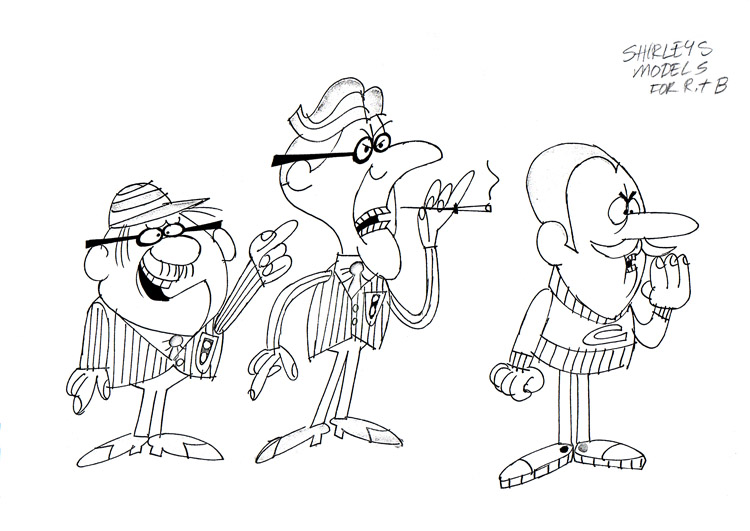
This week I profile Shirley Silvey, one of the unsung designers in animated cartoons.  Besides contributing design work to Mr. Magoo’s Christmas Carol, Shirley had a key role as one of only two storyboard artists on the film.  Her career in the medium lasted less than 20 years but during that short time frame, she was at the epicenter of TV animation in its heyday.  Most of her career was spent at two shops, UPA and Jay Ward, and she shuttled back and forth between the two for many years.  Born Shirley Jonas, both she and her older brother, David, worked as artists in the entertainment field; he became a production illustrator for live action, she went into animation.


Shirley, like many others who worked on Mr. Magoo’s Christmas Carol, was hired as a designer straight out of art school for UPA’s The Boing Boing Show in 1956.  Her first job there was for director Ed Levitt, designing the short The King and Joe.  (Left, one of her concept paintings.) Unfortunately, the series failed to find either a sponsor or an audience and was soon canceled.  After leaving UPA, she had a brief stint at Churchill-Wexler Film Productions, a producer of educational films. 

Before long, Robert Dranko, famed UPA production designer, asked her to come back to UPA and join him on 1001 Arabian Nights, where she really began to blossom under his tutelage, assisting in storyboarding and designing both characters and backgrounds for the film.  When asked about her contributions, Dranko still praised her work 50 years later.


Her assignment complete on 1001 Arabian Nights, Silvey next found employment at the Jay Ward studio, working on Rocky and His Friends and The Bullwinkle Show, again as a storyboard artist and designer.  She joined Roy Morita, who had started slightly before her, and the two would split an entire season’s worth of shows to board and design, each doing an episode in just over three days (approx. 18 pages, six panels per page).  If you've ever wondered why there are continuity issues from the end of one episode to the beginning of another, it's because Shirley and Roy were working simultaneously on back to back episodes in separate locations.  (Below, one of her pages from the Wossamotta U adventure and Silvey's designs for Jay, Filcher and Belcher in the Rue Brittania adventure.)


When boarding ceased, she pitched in doing layouts for other shows in the series, such as Peabody’s Improbable History and Aesop & Son and also served in the same capacities on the 1964 Jay Ward series, Hoppity Hooper.  Shirley worked primarily from home, having been divorced from her first husband, so that she could raise her daughter.  Working freelance necessitates working at a high rate of speed in order to keep the income at a reasonable level; apparently Silvey had no trouble keeping up as she was in constant demand and would jump from one job to another as each job finished.  (Below, Silvey's layout drawing for the Rocky & Friends end credits and some of her character designs for an episode of Aesop & Son)


As mentioned in the book, she rejoined UPA to work on Mr. Magoo’s Christmas Carol doing storyboards and layouts during a hiatus at Ward’s.  When called back to Ward, Bob Singer finished the character layouts for her sequence (the appearance of Jacob Marley).  Some of the sequences she remembered boarding were the prologue, the Cratchit household with the" Lord’s Bright Blessing" song, the Despicables and the deleted sequences with Fan at young Scrooge’s school and at nephew Fred’s house at the end of the original story.


She occasionally did freelance work for UPA in later years; one of her assignments was creating faux "production stills" to help sell The Famous Adventures of Mr. Magoo.  She also freelanced on The Roadrunner Show for Depatie Freleng, who had taken over Looney Tunes production from the defunct Warner Bros. Cartoons division.  Abe Levitow asked her to join him at MGM Visual Arts to storyboard on How the Grinch Stole Christmas but she was unable to do so due to commitments at Ward.  (Below, Silvey's original layout from The Count of Monte Cristo pitch art and the still created from it.  The final character designs bear little resemblance to this preliminary piece.)


Between series’ work at Jay Ward, she would board and layout Cap’n Crunch commercials.  When George of the Jungle came along, Shirley was responsible for laying out the title sequence and also contributed her skills to both the George and Super Chicken segments of the show.

Shirley remarried (and changed her name to Berg) and was able to work in-house in her later years at Ward, where she shared a room with good friend Gloria Wood, key background painter on Mr. Magoo’s Christmas Carol.  During this period, she conceived and pitched a show called Space Granny for which Bill Scott wrote the pilot and she did the boards; unfortunately it was never produced.  Scott named one of the two children Silvey (misspelled in the boards) in Shirley's honor.


When Ward experienced difficulty selling any more new shows to the networks in the 1970s, the studio devoted most of their efforts to Cap’n Crunch spots.  Shirley herself left animation in 1973 (coincidentally, the same year Christmas Carol alum Bob Inman left the business).  She had just spent a particularly grueling gig at Depatie Freleng on the ABC After School Special, The Magical Mystery Trip Through Little Red’s Head.  As her daughter, Beckie, recounts:

In 1973, work at Jay’s was scarce.  She told me she didn't like the direction cartoons were going in.  She didn't like drawing them and didn't think they were funny.  She said she later regretted the decision to retire but by that time it was too late to re-enter the animation industry.  She didn't elaborate further, so I have no idea why she felt that way.  She did begin painting again and took up stained glass but by the late 1970's she had become very ill with severe chemical sensitivities and had to give that up because of the chemicals in the paints.  She was really very ill from that point on until the end of her life.  She was able to sketch and learned watercolors so she could keep going with her art.  One day in the early 1980's she thought she had to find something she could laugh about because her life was so grim, so she began drawing Elliot ( a comic strip) for the next 20 years, and later the Bad Hare (for a series of greeting cards).


Shirley Silvey Berg passed away July 17, 2010 of heart failure.  Her final request was to be buried holding one of her ubiquitous Rapidograph pens in drawing position.