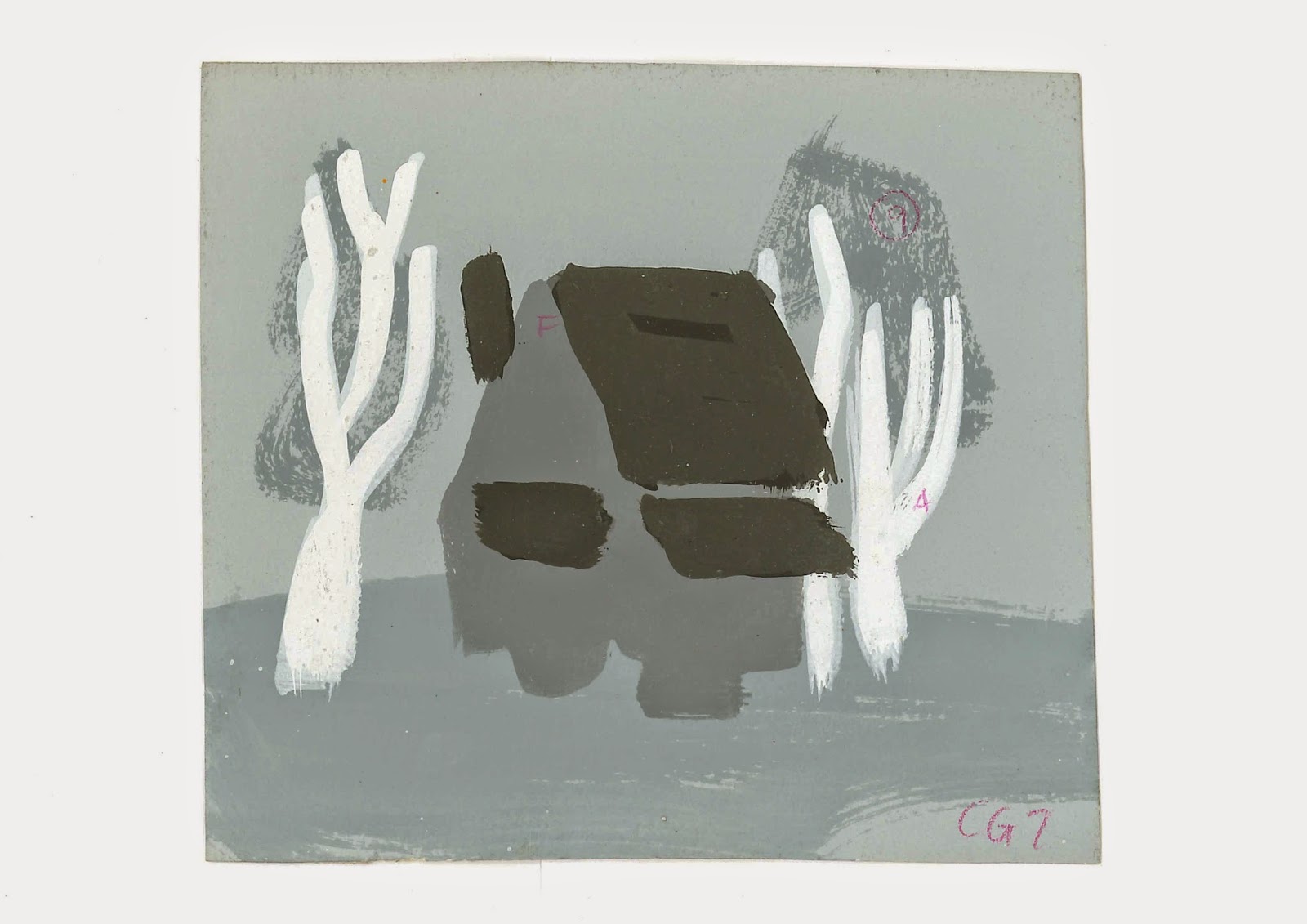
My last post featured Sam Clayberger's color work at UPA for some of the theatrical Magoo cartoons. Concurrent with those shorts, UPA was also producing a high volume of television commercials and in fact, that division was the only one making money for the studio.
Due to the technology of the time, i. e. black & white TV, the spots were executed in shades of gray rather than color. While it might appear simpler to paint in a monochromatic medium, the challenge is in making your values read crisply so items don't blend into the background. Below are few of the thumbnails painted by Sam for some of the myriad commercials done during his time at UPA. Vintage B & W TV ads are difficult to find so none of these have been identified as of yet. If anyone can ID the spots these are from, please let me know.
Mr. Magoo's Christmas Carol
A blog dedicated to the making of the first animated Christmas special, Mr. Magoo's Christmas Carol.
Showing posts with label Mr. Magoo. Show all posts
Thursday, March 19, 2015
Commercials at UPA
Thursday, March 12, 2015
Sam Clayberger, designer at UPA
| Sam Clayberger painting at UPA |
Readers of my book may recall that most of Jay Ward's staff came from UPA after having left the studio as it was collapsing in 1959. While many of the directors at Ward were already old pros by the time they arrived at UPA, most of what would become the design crew at Jay Ward Productions were recent grads of the LA art schools. A prime example of that was Sam Clayberger who, sometime after graduating from Chouinard Art Institute, got a phone call from Chouinard instructor Don Graham informing him of a short term opportunity at UPA moving desks. Sam took the gig and parlayed that "quickie" into a full time job doing layout and later background painting. He left employment at UPA after a few years in order to paint but kept money coming in as a freelancer first at Hanna-Barbera in their early days and later working for Ward as a full-time freelancer so he could continue to paint, later adding teaching at Otis Art Institute into his already full schedule.
Sam recently came across a small stack of his color thumbnails from his brief time at UPA where he worked on a number of Mr. Magoo cartoons, some of which are reproduced here for your enjoyment. First up, Magoo's Cruise from 1958, in which Magoo arrives on a pier for a reunion cruise with old friends but is mistakenly taken on board what appears to be a Soviet submarine. Sam is credited with design and color, which would mean he designed and laid out the backgrounds as well as keying and painting them. (Brief footnote here, one of the animators on each of the shorts listed here was Casey Onaitis, who animated on Mr. Magoo's Christmas Carol.) The last image is an actual production background of the interior of the submarine.
Next, 1957's Magoo's Private War, in which he is credited for design (layout) and co-credited with Ervin Kaplan for color. The color styling was all Sam's making it likely that Erv followed up on the backgrounds. In the cartoon, Magoo mistakes a theatrical war film for an invasion and tries to calm the audience, telling them that "General Clayberger" will be coming to save them. Most of the beginning shots are painted quite hot in contrast to the bulk of the film which takes place in either a darkened theater or on nighttime city streets. The currently available transfer of this film is on the murky side in comparison to these color keys.
Finally, Merry Minstrel Magoo from 1958 wherein Magoo heads down to a TV station to audition for a talent show; Sam is credited with both design (layout) and color:
Unfortunately, these cartoons are not available online so if you'd like to see them to compare them to Sam's originals, you'll have to pick up the boxed set from The Shout Factory which is available here on Amazon. Up next will be some of Sam's keys for black & white UPA commercials. On March 23rd, be sure to check out my Jay Ward blog here for some examples of Sam's beautiful color keys for Jay Ward.

Monday, October 13, 2014
Mr. Magoo and The Features That Never Were
Those who read this blog or who are up on their animation history will know that Mr. Magoo starred in an animated feature, the 1959 release, 1001 Arabian Nights. But how many are aware that it was not the only vehicle considered for a Magoo feature? As with most of film production, there are fits, starts and even different directions taken before arriving at the final destination. So it was with Mr. Magoo and his feature career.The UPA studio had built their reputation in animation on three things--contemporary art, contemporary situations and the use of human characters, rather than animals, to tell their stories. It was a deliberate rejection of Walt Disney's approach to the medium but when they began to contemplate producing a feature, they unconsciously followed Disney's lead when it came to subject matter. All of their proposed features involved non-contemporary or mythical settings and several went back to classic literature. The first to be generate much pre-production work was based on James Thurber's 1945 children's fairy tale, The White Deer. Although the story dealt with something that had become Disney's stock-in-trade, the fairy tale, the studio was quite excited about adapting the work of a contemporary artist like James Thurber.
But it was not to be. It wasn't long before Columbia, UPA's distributor, let it be known that they would feel much more comfortable if the studio built a film around the highly popular character of Mr. Magoo. Seeing the Golden Rule in play here--he who has the gold, makes the rules--UPA acquiesced and announced a feature version of Miguel Cervantes' classic novel, Don Quixote of La Mancha with Mr. Magoo in the title role. Although development work was done on the project, Columbia had subsequently entered into an agreement with a Spanish producer to do a live-action film of the novel and sidelined the animated version.
| ||
| Pitch art for Don Quixote, artist unknown. |
To take its place, two other Magoo vehicles were developed, Robin Hood and 1001 Arabian Nights. When it came time to pick between the two, studio head Stephen Bosustow chose 1001. Jim Backus was aware of the Robin Hood project and in an interview promoting 1001, he provided a small peek behind the scenes, saying "We used to talk and we thought Magoo would be funny in ... maybe Don Quixote. He would be wonderful ... because he is tilting (at) windmills and we finally, I think, hit upon the one universal character, the Aladdin theme of the Arabian Nights. So it's the first feature and I hope not the last. We are also toying with doing Robin Hood ... (Magoo) as Robin Hood ... which would be kind of funny, I would think."
However, the box office failure of 1001 Arabian Nights doomed the notion of any future Magoo features and so decimated the studio's finances that shortly thereafter Bosustow sold UPA to Hank Saperstein. The concept of a Magoo/Robin Hood theatrical feature was lost in the mists of time until a few years ago when a few pieces of the pre-production art for the film first surfaced:
Although a theatrical feature was never produced, "Robin Hood" did later see life as a virtual feature length production, covering a span of 4 episodes for The Famous Adventures of Mr. Magoo just five years later. This time, though, Magoo was no longer playing the role of the title character and was recast as Friar Tuck. Saperstein later edited the four half hours into a complete story and released it theatrically and later the same way on home video. Which leads to an interesting conjecture--was a script written for the proposed feature and did it serve as the basis for the four part TV episode? Saperstein was known for maximizing his return on investment so the idea of recycling an unproduced script would not be far fetched. And innterestingly enough, "Don Quixote" was the only other Famous Adventure to last more than one episode--was this another example of salvaging material from UPA's proposed features? With so little of either the pre- or post-Saperstein UPA archives available, we will probably never know.
![]() | |||
| Lee Mishkin's models for the four part Robin Hood episode |
To read more about UPA's foray into feature films, check out Adam Abraham's essential history of the UPA studio, When Magoo Flew. Special thanks to the Mago0 Admirer for his assistance on this post.
Monday, September 29, 2014
Happy 65th birthday, Mr. Magoo!
On this day in animation history, the first Mr. Magoo cartoon, a Jolly Frolic called Ragtime Bear, was released by Columbia Pictures. Written by Millard Kaufman, laid out by Bill Hurtz and directed by John Hubley, the short changed the fortunes of the nascent UPA studio and later created a merchandising bonanza for Hank Saperstein. You can see a model sheet from the original production right here on this blog from his birthday a few years ago.
There were dozens of cartoons produced featuring the nearsighted Mr. Magoo, a feature, 1001 Arabian Nights, the first animated Christmas special, Mr. Magoo's Christmas Carol, and three separate animated television series: The Mr. Magoo Show, The Famous Adventures of Mr. Magoo and What's New, Mr. Magoo?
Few people below the age of forty even know who Mr. Magoo was and it's safe to say that most anyone younger than that has never even seen a Mr. Magoo cartoon. Its unfortunate that Mr. Magoo was retired long before he turned 65 but here's hoping that another generation rediscovers him. Happy Birthday, Mr. Magoo!
There were dozens of cartoons produced featuring the nearsighted Mr. Magoo, a feature, 1001 Arabian Nights, the first animated Christmas special, Mr. Magoo's Christmas Carol, and three separate animated television series: The Mr. Magoo Show, The Famous Adventures of Mr. Magoo and What's New, Mr. Magoo?
Few people below the age of forty even know who Mr. Magoo was and it's safe to say that most anyone younger than that has never even seen a Mr. Magoo cartoon. Its unfortunate that Mr. Magoo was retired long before he turned 65 but here's hoping that another generation rediscovers him. Happy Birthday, Mr. Magoo!
![]() |
| Mr. Magoo enjoying his retirement |
Monday, November 26, 2012
Mr. Magoo’s Christmas Carol soundtrack
As part of the 50th anniversary edition of the
book, I had proposed including a soundtrack which was to have featured the film’s
song score, Styne & Merrill’s demo recordings of their tunes and Walter
Scharf’s underscore. The idea was well received and Classic Media was
on board so I built the book around this proposal. The songs had been released on
iTunes back in 2010 and the long lost Overture had been discovered, too, so it
seemed like the project would fall into place and finally, the long
awaited original film soundtrack would be released, 50 years after the
film had made its debut.
Unfortunately, when the digging really began in earnest, it
was discovered that the only musical material that existed in the vaults were
the previously released songs and Overture.
For those with an attuned ear, it’s clear that the iTunes-released songs
are from the original recording session; the final standalone versions of the
songs cannot be located. Equally
disappointing, the score didn’t exist in any form whatsoever; not the original
scoring session takes, not as a standalone score, not even as a mixed music and
sound effects track commonly used for foreign language dubbing.
It was, and is, a major disappointment. What seems likely is that the elements are mislabeled or filed incorrectly in the vault. According to a former executive at UPA, the elements were delivered when the assets were purchased. At some point in the future, when the missing
elements are located, the intent is to still release an original soundtrack. Until that day, we’ll have to content
ourselves with the track that currently exists on the DVD releases.
Monday, November 5, 2012
The 50th Anniversary Edition is here!
It's finally here! Pictured above is the 50th anniversary collector's edition of Mr. Magoo's Christmas Carol, The Making of the First Animated Christmas Special. For those wondering if they should order
this edition, I've decided to answer a few questions on how and why this
book came about.
Why a 50th anniversary edition of a book that's been out for several years?
When I first published the book in 2009, I had proposed doing a special edition for the 50th anniversary in 2012 figuring it was several years away. The first book did better than anyone expected and sold out quickly. It wasn't in my plans but due to demand, I decided to do a second run with corrections inserted wherever I could. That edition is on the verge of selling out now.
In October of last year, a good friend asked me if I was still going to do a 50th book. I told him it was time to move on but he made it clear he felt something needed to be done to commemorate the 50th anniversary of the special and this might be the only thing to happen. Not only that, he was willing to put his money where his mouth was. Although touched, I still wasn't completely convinced. It was only after I mentioned it to several other interested parties who were also willing to support the project that I agreed to do it.
Isn't this just a ploy to sell the same book three times over?
I'm not that smart. This is not a money-making venture. If it weren't for the 'angel investors' mentioned above, this book wouldn't exist. Those 'angels' have to be paid back from the proceeds of book sales, not an easy task when the print run is so low. Also, as I mentioned above, there was never supposed to be a second printing and although this edition uses the same format as the previous ones, it has been thoroughly revised and expanded. It is no easy job to tear apart a book, insert hundreds of images and add text without destroying the narrative and then stitch it all back together.
Then what's different about this edition as opposed to the previous printings?
As I mentioned in a previous post, the book has been expanded to 176 pages from the original 128. There are close to twice as many illustrations now, 435 vs. the original 232, which include: photos which were eliminated from the previous editions due to space restrictions, frames from the re-mastered film when no art could be found to reflect the text, discarded art from deleted sequences which give a glimpse into the production process and a large amount of new production art, most of which was discovered since the last printing. I had hoped to include some images from Ronald Searle’s illustrations of "A Christmas Carol", showing the influence he had on this production, but the Searle attorneys were dismissive. Fortunately, Timex was far more cooperative and there are some frames from the original opening credits.
The book features heavier board and paper stock, printed endpapers, cloth binding in a cloth bound slipcase with gold foil stamping and limited to 250 numbered copies.
Can I buy this at my local bookstore or on Amazon?
Yes and no. Book retailers have an unfortunate habit of damaging books somewhere along the supply line; the publisher has to bear the cost of shipping the book to the distributor, having it become damaged and therefore no longer sell-able, and then paying to have the book shipped back. It makes no sense on a premium book like this to risk that kind of damage and expense. Although I may make the book available on Amazon, regardless of where you buy it, here or there, it will be coming from me. It will not be available at your local bookstore.
If you want to order the book, you can get it here. It's the definitive edition and when it's gone, it's gone.
Why a 50th anniversary edition of a book that's been out for several years?
When I first published the book in 2009, I had proposed doing a special edition for the 50th anniversary in 2012 figuring it was several years away. The first book did better than anyone expected and sold out quickly. It wasn't in my plans but due to demand, I decided to do a second run with corrections inserted wherever I could. That edition is on the verge of selling out now.
In October of last year, a good friend asked me if I was still going to do a 50th book. I told him it was time to move on but he made it clear he felt something needed to be done to commemorate the 50th anniversary of the special and this might be the only thing to happen. Not only that, he was willing to put his money where his mouth was. Although touched, I still wasn't completely convinced. It was only after I mentioned it to several other interested parties who were also willing to support the project that I agreed to do it.
Isn't this just a ploy to sell the same book three times over?
I'm not that smart. This is not a money-making venture. If it weren't for the 'angel investors' mentioned above, this book wouldn't exist. Those 'angels' have to be paid back from the proceeds of book sales, not an easy task when the print run is so low. Also, as I mentioned above, there was never supposed to be a second printing and although this edition uses the same format as the previous ones, it has been thoroughly revised and expanded. It is no easy job to tear apart a book, insert hundreds of images and add text without destroying the narrative and then stitch it all back together.
Then what's different about this edition as opposed to the previous printings?
As I mentioned in a previous post, the book has been expanded to 176 pages from the original 128. There are close to twice as many illustrations now, 435 vs. the original 232, which include: photos which were eliminated from the previous editions due to space restrictions, frames from the re-mastered film when no art could be found to reflect the text, discarded art from deleted sequences which give a glimpse into the production process and a large amount of new production art, most of which was discovered since the last printing. I had hoped to include some images from Ronald Searle’s illustrations of "A Christmas Carol", showing the influence he had on this production, but the Searle attorneys were dismissive. Fortunately, Timex was far more cooperative and there are some frames from the original opening credits.
The book features heavier board and paper stock, printed endpapers, cloth binding in a cloth bound slipcase with gold foil stamping and limited to 250 numbered copies.
Can I buy this at my local bookstore or on Amazon?
Yes and no. Book retailers have an unfortunate habit of damaging books somewhere along the supply line; the publisher has to bear the cost of shipping the book to the distributor, having it become damaged and therefore no longer sell-able, and then paying to have the book shipped back. It makes no sense on a premium book like this to risk that kind of damage and expense. Although I may make the book available on Amazon, regardless of where you buy it, here or there, it will be coming from me. It will not be available at your local bookstore.
If you want to order the book, you can get it here. It's the definitive edition and when it's gone, it's gone.
Monday, October 22, 2012
The Recording of Mr. Magoo's Christmas Carol, Pt. 1
In
readying the 50th anniversary edition of the book, I did a little more research into the
facilities where Mr. Magoo's Christmas Carol was recorded-the dialogue, the
songs and the score. In the first
edition, I had chased all that information down, even to looking for the vaults
where the recorded material might have been stored. This time I was more interested in the
recording facilities themselves and briefly considered adding images of the studios to the book while providing
a little more history on the places.
Unfortunately, inserting this material proved disruptive to the narrative flow of
the book so I decided to post it on the blog.
![]() |
| Altec Lansing crew, ca. 1944 |
![]() |
| Photo from 2009, facade has since been covered by vegetation. |
Although UPA had a recording studio, as
with many of the pre-production aspects of Mr. Magoo's Christmas Carol, Orgel went for the best,
booking his dialogue sessions at Ryder Sound Services. The late Laura Olsher recalled that between the day's sessions, the actors went
upstairs for lunch at a place called The Grapevine. I have not been able to find corroborating
information regarding the restaurant but I have no reason to doubt her
memory. A real estate listing from a few
years ago shows a loft, which would have been the eatery in its heyday.
At
the time of the recording sessions, the building still retained its old LA
charm. Since then, it has seen a a variety of uses, and has lost some of its original appeal, being painted a deep red with vegetation allowed to
obscure its façade. It’s currently home to
Stereo D, a provider of 3D conversion services to the motion picture industry.
Monday, October 15, 2012
Monday, October 8, 2012
Mr. Magoo and Rheingold beer
In a post last year, I discussed Magoo and his shilling for
two different beers, Rheingold and Stag. A few of the Stag spots have survived over
the last 50+ years and can be found on various DVD commercial collections and
on Youtube. However, the Rheingold spots
have yet to materialize in their full form as commercials. We can get a little peak at what one of them looked
like from some recently discovered storyboards, thumbnails presumed to be drawn by Magoo director, Pete Burness. Click on each image to see it larger:
Monday, October 1, 2012
Mr. Magoo and UPA
Last January, I mentioned that there would be several Magoo
related items being released this year.
The first was the seminal history on the UPA studio, When Magoo Flew, by Adam Abraham. It tells the story of the unique studio that
revolutionized animation design but was plagued by indecision, weak stories and
poor production management, all of which eventually did it in. While the studio eschewed what it felt were the rigid formulas of the other studios' output, UPA was no less rigid in it's ideological viewpoint; any mention of Warner Bros. cartoons, for example, was strictly verboten. Bill Scott, head writer for Jay Ward, who wrote for both Warner Bros. and UPA, concurred: "To begin with, you never mentioned Warner Bros.! The kiss of death at UPA was to be considered a Warner Bros. writer." Gerard Baldwin, in his upcoming autobiography, recalls how Chuck Jones, who had directed an early UPA effort, Hell Bent for Election, eagerly screened his first Roadrunner film, Fast and Furryous, for the UPA artists to deafening silence. The audience filed out silently and Jones slunk back to his car, alone, film in hand. It also appears to have been a studio not for
the faint of heart, at least if you were in the top echelon of artists. While the artists were outspoken in their
opinions of the other animation studios of the time, they reserved the long
knives for themselves , often turning on each other through political jockeying
and power plays. Many consider Hank Saperstein’s ruthless takeover of the company as the destruction of a once great enterprise but this
book makes it clear that the foundation for its demise was in place long before
then. Highly recommended.
Another new release for this year was the UPA boxed set, a
retrospective of all the studio’s non-Magoo cartoons (although it does include Magoo’s
first cartoon, The Ragtime Bear). The UPA library has been difficult to
find on video and no complete collection of the studio’s cartoons has ever been
released before. The set is a great
companion piece to Abraham’s book as it provides a visual counterpart to his
text and illustrates both the strengths and weaknesses of the studio’s
theatrical output and makes it clear that UPA's reputation was made off
of a surprisingly small group of films. Despite this, the studio's impact on animation design continues to reverberate today. Most of
the transfers are gorgeous, allowing a viewer to better comprehend the design
and color that made the studio so renown.
Last but not least was a boxed set of the complete
theatrical Magoo cartoons including his feature debut, 1001 Arabian
Nights, which has been long out of print. Unfortunately, this set, which
was scheduled for release first in February, then June and finally December, has
been pushed back yet again and will not be released until sometime next
year. The good news is that the delay is
due to the fact that all the cartoons are being digitally remastered from the
original negatives and it’s taking Sony longer than originally anticipated. However,
if the UPA boxed set is any indication, it will be worth the wait. I will update this blog when there is more
news to report on the collection.
Subscribe to:
Posts (Atom)