Mr. Magoo's Christmas Carol

A blog dedicated to the making of the first animated Christmas special, Mr. Magoo's Christmas Carol.
Showing posts with label Lee Mishkin. Show all posts

Monday, January 5, 2015

Lee Orgel and The New Three Stooges


While it couldn't be considered a high point in either Lee Orgel's or The Three Stooges' career, this minor series, which was both developed and produced by Lee, might be the first animated TV series to feature live characters as animated renditions of themselves.  To tie the show into the past, the Stooges themselves appeared in live-action wraparounds directed by former Stooge director, Edward Bernds.  Lee followed this show up by developing an Abbott and Costello series, which was produced at Hanna-Barbera, and before too long Saturday morning shows abounded with live-action knock-offs--Lassie, Partridge Family 2200 AD, The Brady Bunch, Gilligan's Planet, Star Trek, The Addams Family, ad nauseum.  Apparently, familiarity was a winning formula with the networks.

Nevertheless, the animated Stooges kept a lot of animation talent employed in the mid-1960s, including such key contributors to Mr. Magoo's Christmas Carol as production designer Lee Mishkin, background painters Bob Inman and Gloria Wood and layout artist Corny Cole.  The show was produced in West Hollywood at Cambria Productions (the same folks who gave us Clutch Cargo) from 1965-66.


Character layouts by Corny Cole
The first episode in the series, That Little Old Bombmaker (which was a play on the Italian Swiss Colony wine commercials of the time, "that little old winemaker, me!"), was laid out by Corny Cole.  A small sample of his layout drawings for this episode were discovered in the same mis-marked boxes mentioned in a previous blog post.  Very little art from the series seems to have survived making these quite rare.  Like most of TV animation from the era, one can see that quality of the drawing in the layouts was seldom reflected in the animation.


The model drawings below appear to be drawn by Lee Mishkin.


Monday, October 13, 2014

Mr. Magoo and The Features That Never Were

Those who read this blog or who are up on their animation history will know that Mr. Magoo starred in an animated feature, the 1959 release, 1001 Arabian Nights.  But how many are aware that it was not the only vehicle considered for a Magoo feature?  As with most of film production, there are fits, starts and even different directions taken before arriving at the final destination.  So it was with Mr. Magoo and his feature career.

The UPA studio had built their reputation in animation on three things--contemporary art, contemporary situations and the use of human characters, rather than animals, to tell their stories.  It was a deliberate rejection of Walt Disney's approach to the medium but when they began to contemplate producing a feature, they unconsciously followed Disney's lead when it came to subject matter.  All of their proposed features involved non-contemporary or mythical settings and several went back to classic literature.  The first to be generate much pre-production work was based on James Thurber's 1945 children's fairy tale, The White Deer.  Although the story dealt with something that had become Disney's stock-in-trade, the fairy tale, the studio was quite excited about adapting the work of a contemporary artist like James Thurber.

But it was not to be.  It wasn't long before Columbia, UPA's distributor, let it be known that they would feel much more comfortable if the studio built a film around the highly popular character of Mr. Magoo.  Seeing the Golden Rule in play here--he who has the gold, makes the rules--UPA acquiesced and announced a feature version of Miguel Cervantes' classic novel, Don Quixote of La Mancha with Mr. Magoo in the title role.  Although development work was done on the project, Columbia had subsequently entered into an agreement with a Spanish producer to do a live-action film of the novel and sidelined the animated version.

 
Pitch art for Don Quixote, artist unknown.

To take its place, two other Magoo vehicles were developed, Robin Hood and 1001 Arabian Nights.  When it came time to pick between the two, studio head Stephen Bosustow chose 1001.  Jim Backus was aware of the Robin Hood project and in an interview promoting 1001, he provided a small peek behind the scenes, saying  "We used to talk and we thought Magoo would be funny in ... maybe  Don Quixote.  He would be wonderful ... because he is tilting (at) windmills and we finally, I think, hit upon the one universal character, the Aladdin theme of the Arabian Nights. So it's the first feature  and I hope not the last. We are also toying with doing Robin Hood ... (Magoo) as Robin Hood ... which would be kind of funny, I would think."   

However, the box office failure of 1001 Arabian Nights doomed the notion of any future Magoo features and so decimated the studio's finances that shortly thereafter Bosustow sold UPA to Hank Saperstein.  The concept of a Magoo/Robin Hood theatrical feature was lost in the mists of time until a few years ago when a few pieces of the pre-production art for the film first surfaced:


Although a theatrical feature was never produced, "Robin Hood" did later see life as a virtual feature length production,  covering a span of 4 episodes for The Famous Adventures of Mr. Magoo just five years later.  This time, though, Magoo was no longer playing the role of the title character and was recast as Friar Tuck.  Saperstein later edited the four half hours into a complete story and released it theatrically and later the same way on home video.  Which leads to an interesting conjecture--was a script written for the proposed feature and did it serve as the basis for the four part TV episode?  Saperstein was known for maximizing his return on investment so the idea of recycling an unproduced script would not be far fetched.  And innterestingly enough, "Don Quixote" was the only other Famous Adventure to last more than one episode--was this another example of salvaging material from UPA's proposed features?  With so little of either the pre- or post-Saperstein UPA archives available, we will probably never know. 

Lee Mishkin's models for the four part Robin Hood episode


To read more about UPA's foray into feature films, check out Adam Abraham's essential history of the UPA studio, When Magoo Flew.  Special thanks to the Mago0 Admirer for his assistance on this post.

Thursday, November 18, 2010

Christmas Belles

One of the biggest pleasures in writing the book was finding out how many people loved the special and were excited to read about its genesis.  One of those was a fellow animator, who visited me at my office to buy a copy of the book last year  and whose interest in animation dated back to his teen years in the early 1960s.  He used to haunt the dumpsters in back of the various animation studios around Los Angeles and his rescue efforts paid off in some rather unique and  interesting finds. 

At UPA, for example, he discovered Abe Levitow's original model sheet drawings for the 1960s Mr. Magoo model in the trash,

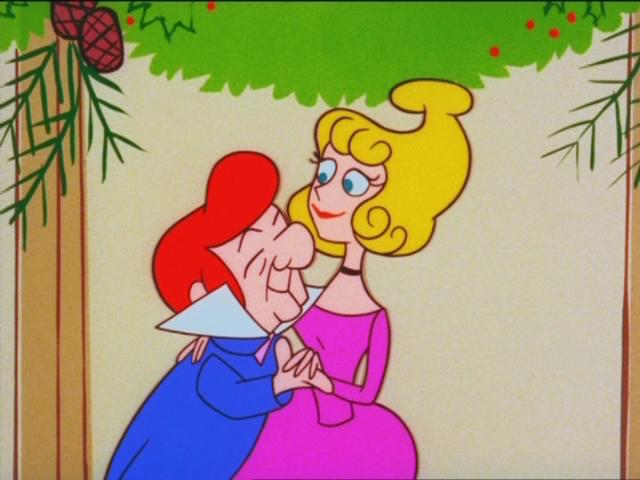
as well as some of the most unusual items from the special to come to my attention.  As he went through his stack, he showed me some cels from the show-not just the standard production cels but cels which had a very different version of Belle on them.  This Belle was the one designed by Tony Rivera,

and not the one we know from the special, as designed by Lee Mishkin.  

Unlike the cels of the Tony Rivera’s three ghosts depicted in the book (p. 84), these were not suggested model cels of Belle but the same model from three different scenes, sequentially numbered, indicating they were random cels from those scenes.  These were production cels!

To say the least, it was a rather stunning find.  Later, another collector showed me a character layout with the same model of Belle, yet more evidence of a mid-production change.  Recently, I had the chance to examine the original scene folders for this sequence and found notes on them indicating that the scenes had indeed been re-animated.  There's no doubt this sequence was first animated, inked, painted and shot using the Tony Rivera model of Belle.  

I mention this in the audio commentary track on the new DVD release but here you have the opportunity to see the difference first hand. Tony's model of Belle, while simple, is still appealing but the animator for these scenes seems to have completely lost the charm inherent in the original design.  As the DVD feature "From Pencil to Paint" shows, the animators relied heavily on the character layouts as guides for their animation, consequently the layout artist for this sequence also shares some responsibility.  Rivera's clean graphic design has deteriorated into a series of undulating lines defining virtually nothing.  A sensitive hand was needed to translate his graphic sensibility into animation; lacking that, a new approach was required. 


Arguments could certainly be made regarding the quality of draftsmanship in the revised scene but this version of Belle is more feminine and far easier on the eyes.  What was difficult to comprehend is that on a film which clearly did not have a luxurious budget, an entire sequence would make it all the way through the production process to final color, only to be redone.  Making the decision to completely redo it was an expensive one although it also appears to have been the right one.   To compare it to live action, it was as if the sequence had been shot with one actress only to realize there was no chemistry and it had to be recast and reshot with a new actress.