
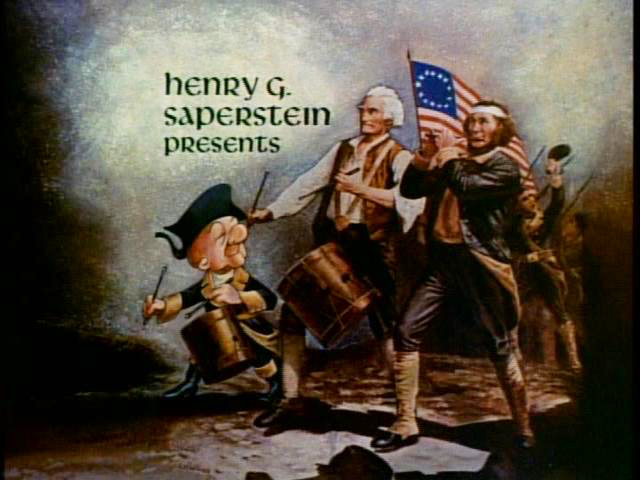
The title sequence for Famous Adventures, newly released on DVD, is an enjoyable romp through history featuring Mr. Magoo in classic artistic and historical tableaus. If one could trace its genesis, the concept might have had its beginnings in UPA’s feature, Gay Purr-ee. Within that film is a memorable sequence in which one of the key production designers, Corny Cole, painted the cat Mewsette into a number of French Impressionist paintings by Lautrec, Van Gogh, Cezanne, Rousseau, etc. A few years later, when asked to create a title sequence for the new Magoo series, two UPA production designers expanded the concept, painting Magoo on a Greek vase, into a Japanese painting, rendering him as the Mona Lisa and dropping him into several other well-known styles and works of art. It’s a witty beginning for the show and sets the tone for Mr. Magoo to appear in literature through the ages. The two artists, Jacques Rupp and Don Morgan, received credit for the title sequence on every single episode although they did much more on the series. Hank Saperstein had a rule that each person could only receive one credit so they opted for the credit that would appear every week, giving them the most exposure.
Jacques Rupp

Jacques was the more senior of the two, having already spent a decade in animation, while Don Morgan had only recently entered the business. Rupp started at Disney in 1953 as in inbetweener and moved into the layout department as an assistant on Lady and the Tramp, working on sequences at the dog pound, the zoo and the classic spaghetti eating sequence at Tony’s restaurant. He spent time in the Disney commercials unit as a background painter and also worked in Ward Kimball’s unit for the Man in Space series and Magic Highway USA.
Rupp was moved off of production to work on the new theme park, Disneyland, and is credited with designing the Snow White shuttle bus which ran from Los Angeles to Anaheim, logos, popcorn boxes and cups used throughout the park and selecting costumes for the Jungle Cruise, Canal Boats and Frontierland. Jacques went on to become something of an immortal in the Disney pantheon, designing the classic Disneyland logo as well as the opening titles for the Disneyland TV show featuring Tinkerbell and Sleeping Beauty’s castle.
 | |
| One of Jacques Rupp's layouts from the Cyrano episode |
Jacques probably left Disney during its mass layoff in the late 50s and arrived at UPA in time to design the title sequence and promotional materials for the Magoo feature, 1001 Arabian Nights. When that picture finished, he went on to do television commercials for one of the many animation production houses in Los Angeles, Animation, Inc. Many artists working in animation during the early 60s have recounted how difficult the job market was at the time and artists often found themselves hopping from studio to studio picking up work wherever they could. Rupp was no exception and finally landed at Hanna Barbera as a layout artist working on The Flintstones, Hey There, It’s Yogi Bear!, Ricochet Rabbit, Punkin’ Puss and early development on The Jetsons. When that gig ended, he found himself doing animated titles for Pacific Title before coming back to UPA for The Famous Adventures of Mr. Magoo. As mentioned above, he and Don Morgan collaborated on the title sequence but both also laid out episodes for the series, Cyrano De Bergerac being one of Rupp’s episodes.
 |
| One of Rupp's personal works |
Unlike theatrical animation, the television animation business was largely a freelance affair and it became more so as time went on. Jacques continued to move from studio to studio, next stopping at Lee Orgel’s production of The New Three Stooges , then to Depatie Freleng for The Super 6, and Super President, Filmation for The Batman/Superman Hour and finally back to Depatie Freleng for The Pink Panther series before leaving the industry altogether. Rupp moved to Seattle where he worked for the University of Washington doing graphics and storyboarding and later freelanced for the Seattle Times, where he designed their masthead. He retired in 1986 and passed away in 2000. You can see some of Rupp's Disney print work here.
Don Morgan

 Morgan and Rupp conceived and executed the title sequence for the series and Saperstein was so taken with the titles that he asked Don to paint a series of 8 images inserting Magoo into famous paintings for use as corporate gifts. In addition to the title sequence, Morgan did the individual episode titles and worked on the Moby Dick, Frankenstein and Dick Tracy episodes, among others, and would also design or paint on any episode that needed a helping hand. During production on the series, Morgan also picked up freelance on the Magoo GE commercials, earning a little extra on the side. When production was complete on Famous Adventures, the entire staff was laid off and Saperstein closed the studio. Abe rejoined his old friend, Chuck Jones, over at Tower 12 Productions, which soon became the newest incarnation of MGM Animation. Don followed Abe over there to lay out Tom & Jerry cartoons under Maurice Noble’s tutelage.
Morgan continued to work with Noble on the studio’s next project, the classic Christmas special, How the Grinch Stole Christmas, laying out sequences such as the Grinch’s thefts in the village, the sleigh sequence on the top of the mountain and the end sequence with the Whos singing in Whoville. Later, he was excited to work with longtime comic strip hero, Walt Kelly, on The Pogo Special Birthday Special, in which he laid out the entire picture brush inking all the layouts in the style of Kelly’s iconic strip. Morgan also served as a friendly ear for Kelly, who was less than enchanted with Jones’ interpretation of his characters and would blow off steam over drinks with Don. When Walt Kelly later fell ill, Morgan ghosted Walt Kelly’s Pogo strip until he died, when Walt’s widow, Selby, took over.

Morgan worked again with Abe Levitow on Off to See the Wizard, The Phantom Tollbooth, ABC’s The Curiosity Shop and later back at UPA for Uncle Sam Magoo. After a few turbulent but stimulating years working with Ralph Bakshi on three features, he served as layout Supervisor at Hanna Barbera for all the Saturday morning TV productions; while there, he worked with director Gerard Baldwin on developing The Smurfs animated series. In later years, he worked at Marvel as Studio Art Director and at both Turner Animation and Nickelodeon as Layout Supervisor. Don spent his last years in the animation business at Dreamworks, working on such hand-drawn features as The Road to El Dorado and Spirit, Stallion of the Cimmaron before retiring to a ranch in central California where he and his wife, Maggie, teach the arts and skills of Early American frontier living to their many grandchildren. You can see Don interviewed in the featurette, Oh Magoo, You've Done It Again!, included on the Magoo on TV boxed set.
Special thanks to Gord Wilson for his Jacques Rupp interview


