Mr. Magoo's Christmas Carol

A blog dedicated to the making of the first animated Christmas special, Mr. Magoo's Christmas Carol.
Showing posts with label Tony Rivera. Show all posts

Thursday, November 18, 2010

Christmas Belles

One of the biggest pleasures in writing the book was finding out how many people loved the special and were excited to read about its genesis.  One of those was a fellow animator, who visited me at my office to buy a copy of the book last year  and whose interest in animation dated back to his teen years in the early 1960s.  He used to haunt the dumpsters in back of the various animation studios around Los Angeles and his rescue efforts paid off in some rather unique and  interesting finds. 

At UPA, for example, he discovered Abe Levitow's original model sheet drawings for the 1960s Mr. Magoo model in the trash,

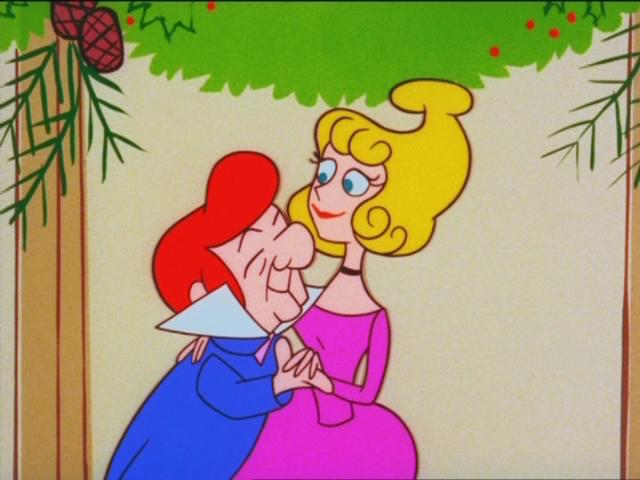
as well as some of the most unusual items from the special to come to my attention.  As he went through his stack, he showed me some cels from the show-not just the standard production cels but cels which had a very different version of Belle on them.  This Belle was the one designed by Tony Rivera,

and not the one we know from the special, as designed by Lee Mishkin.  

Unlike the cels of the Tony Rivera’s three ghosts depicted in the book (p. 84), these were not suggested model cels of Belle but the same model from three different scenes, sequentially numbered, indicating they were random cels from those scenes.  These were production cels!

To say the least, it was a rather stunning find.  Later, another collector showed me a character layout with the same model of Belle, yet more evidence of a mid-production change.  Recently, I had the chance to examine the original scene folders for this sequence and found notes on them indicating that the scenes had indeed been re-animated.  There's no doubt this sequence was first animated, inked, painted and shot using the Tony Rivera model of Belle.  

I mention this in the audio commentary track on the new DVD release but here you have the opportunity to see the difference first hand. Tony's model of Belle, while simple, is still appealing but the animator for these scenes seems to have completely lost the charm inherent in the original design.  As the DVD feature "From Pencil to Paint" shows, the animators relied heavily on the character layouts as guides for their animation, consequently the layout artist for this sequence also shares some responsibility.  Rivera's clean graphic design has deteriorated into a series of undulating lines defining virtually nothing.  A sensitive hand was needed to translate his graphic sensibility into animation; lacking that, a new approach was required. 


Arguments could certainly be made regarding the quality of draftsmanship in the revised scene but this version of Belle is more feminine and far easier on the eyes.  What was difficult to comprehend is that on a film which clearly did not have a luxurious budget, an entire sequence would make it all the way through the production process to final color, only to be redone.  Making the decision to completely redo it was an expensive one although it also appears to have been the right one.   To compare it to live action, it was as if the sequence had been shot with one actress only to realize there was no chemistry and it had to be recast and reshot with a new actress.

Monday, October 18, 2010

Tony Rivera, designer


Tony Rivera was the first of two character designers to work on Mr. Magoo’s Christmas Carol and probably the very first artist to work on the film.  As discussed in the book, before the storyboard artists could begin to delineate the story they needed character designs, most of which were provided by Rivera.   Some of his preliminary designs were later modified for animation production by designer Lee Mishkin.  Tony's work on the special is highlighted in the book on pages 59-61.

Unlike many of the other staffers on Mr. Magoo’s Christmas Carol, Tony Rivera was already a long time veteran in animation, having started at Disney in 1934 as a 21 year old.  He worked his way up through the apprentice system there, eventually becoming one of Grim Natwick’s assistants for the character of Snow White.  Tony was apparently a strong draftsman with a facility for drawing pretty women, elevating him above many other assistants at the time. 

 
 After the notorious Disney strike in 1941, Rivera returned to work there for a few months but ultimately left the studio for a life of freelance, in an era when that was far from commonplace.  He spent most of the war years working in layout at Screen Gems, MGM (Hanna Barbera’s Tom & Jerry unit) and Walter Lantz.  For the rest of his career, he managed to work at virtually every commercial, industrial, television and theatrical studio in the business, a testament to his skills and versatility. 

During the 50s, he picked up from John Sutherland, Shamus Culhane, Tempo, Ray Patin, Playhouse, Quartet, Norman Wright, Frank Capra and UPA as well as many others.  UPA became a return customer, with Rivera working there in its theatrical shorts era in 1951 and later returning for a longer period to do design and story sketch on their first feature, 1001 Arabian Nights, which was his first gig with director Abe Levitow.  

Tony did layout on Hanna Barbera’s early TV efforts, Huckleberry Hound and Quick Draw McGraw, before Abe called him back to UPA to design and layout the last two Magoo theatrical shorts, which were later included in the TV package, Magoo Meets Frankenstein and Magoo Meets McBoing Boing.  Levitow made use of Rivera’s talents many times after that, on such films as Mr. Magoo’s Christmas Carol , The Famous Adventures of Mr. Magoo, The Phantom Tollbooth, Uncle Sam Magoo and finally at Levitow Hansen films on BC: The First Thanksgiving TV special.  Other production houses that made use of Tony’s skills were Depatie-Freleng, Ed Graham for (Linus the Lion Hearted) and Ralph Bakshi.

 
Tony was honored by the animation union in 1985 for 50 years of service to the industry and passed away in 1986.  By all accounts, Tony Rivera was a quiet unassuming man who simply did his work and did it well.  Floyd Norman (who has also worked at most major studios, most recently Disney and Pixar) remembers working with Tony at Hanna Barbera:

I was lucky enough to work with Jose "Tony" Rivera at Hanna Barbera.  It was Tony's final years in the cartoon business yet he was still in top form. It was such a joy to work with a guy who had made so many of the cartoons I saw as a child. He was on my layout crew, but I could hardly call myself his supervisor. Tony had forgotten more than I would ever know.

I wish I had some great stories to tell, but the only thing Tony did was sit at his desk and do great work. Sometimes he would come to Scott Shaw or myself and ask us a layout question (as if he needed to). Scott and I felt that Tony was trying to make us feel like we were doing our jobs. What ever question he would ask - he clearly already knew the answer. That's the kinda guy Tony was. A very sweet man.

When Tony passed away, Scott and I attended his memorial service.  There were mainly family and friends in attendance. Not many from the animation business. Sadly, most of those who had worked with Tony had already passed away.

I'll never forget Tony Rivera. No assignment we handed out would ever stump him. He always did a masterful job and completed it ahead of schedule. He was a fantastic layout artist. . . he could do anything - and often did.
You can see more of Tony's work and drawings of him by his colleagues at his son's website here.  Click on Pop's Cartoons.

Monday, September 27, 2010

Ronald Searle and Mr. Magoo's Christmas Carol


The British Invasion as a pop cultural reference usually refers to the wave of British bands that began to infiltrate American pop music starting in 1962. However, there was a sort of pre-British Invasion when it came to the culture in general. The vanguard was led by several British-themed musicals and plays in 1960-Robert Bolt’s A Man For All Seasons, Lerner and Lowe’s Camelot and most importantly for Mr. Magoo, Oliver!, with music, lyrics and book by Lionel Bart and based on Charles Dickens’ Oliver Twist.


Shortly after the debut of the Dickens musical, an edition of A Christmas Carol with illustrations by Ronald Searle, the renowned British cartoonist, was published. (World Publishing Co., copyright 1960, 1961.) Searle illustrated two more of Dickens’ works, Great Expectations and Oliver Twist, both published in 1962. The Magoo special had its debut on the NBC network in December 1962.


It appears that Dickens was experiencing a bit of a cultural renaissance and both Bart’s musical and Searle’s book had a hand in the genesis of Mr. Magoo's Christmas Carol. The success of Oliver! clearly influenced the decision to make an animated musical based on A Christmas Carol and Searle's book seems to have inspired the artists at UPA as they designed the special-a UPA stamped copy of the book was found in Abe Levitow’s personal collection of material from the film.

Ronald Searle

Below are a few indications of Searle's influence: 

This early pre-production art shows the strongest Searle influence, artist unknown

A greatly simplified version of the fiddler by designer Lee Mishkin


Lee Mishkin simplified Fezziwig's and his wife's costumes for animation

Searle's drawing from the book has been flopped  for comparison

Tony Rivera's design for the turkey boy as animated by Duane Crowther

These few designs by Lee Mishkin and Tony Rivera unfortunately pale in comparison to Searle's florid line work but the two were working in a different discipline and constricted by production methodology and budget. Viewed by themselves, the designs are extremely appealing and contribute enormously to the charm of the film.

Mishkin was not alone in referencing Searle; many of his contemporaries were also influenced by Ronald Searle's work. In fact, Searle caught Disney designer Tom Oreb poaching what he felt was his horse design for Samson in Sleeping Beauty, and the host and contestants on "What's My Crime?" in 101 Dalmatians, also designed by Oreb, have a distinctly Searle feel to them. Even the line work in the backgrounds for 101 Dalmatians,created by layout man Ernie Nordli, echoes Searle's own backgrounds.

To see more from Ronald Searle's lavishly illustrated edition of A Christmas Carol, as well as his other Dickens' editions, click here.