Mr. Magoo's Christmas Carol

A blog dedicated to the making of the first animated Christmas special, Mr. Magoo's Christmas Carol.
Showing posts with label Mr. Magoo's Christmas Carol book. Show all posts

Monday, November 16, 2020

Back in print!


 After 8 years of being out of print, I'm pleased to announce that my book on the making of the first animated Christmas special is back in print!  But wait, there's more!  This edition is softcover but instead of reprinting the 2009 book, this is a reprint of the 2012 deluxe slipcased 50th anniversary edition, which had 48 more pages than the original and over 200 more images.  This edition has the added bonus of 2 more pages with 6 more rare photos from the song recording session, photos that were uncovered years after the deluxe edition had sold out.  

To sum up, this printing has 180 pages vs the original edition's 128 pages and 439 images vs 232 in the original.  Because of the limited print run of the deluxe version (only 250 copies), very few people have seen the extra material.  If you only own the first printing, you owe it to yourself to get this version, it's the most complete edition ever printed.  Available online only from the usual suspects like Amazon and Barnes & Noble.

Thursday, December 3, 2015

The making of Mr. Magoo's Christmas Carol

Welcome to my 100th post on this blog!  It's been 6 years since I published the first edition of Mr. Magoo's Christmas Carol: The Making of the First Animated Special, which recounted the virtually lost story of two Broadway songwriters, Styne and Merrill, and the once cutting-edge animation studio, UPA, both of whom had an outsized impact on all future animated Christmas specials.  The book that no publisher would take on went through two sold-out printings and an out-of-print special commemorative 50th anniversary edition because I decided the story was compelling enough to publish it myself.

I'm sorry to say that the limited print runs have ensured that any edition of the book you can find from third party vendors will now likely be both rare and pricey.  However, if you're looking for a special Christmas gift or just want to get the book before it's gone forever, I recently discovered a few treasures in storage so here's your last chance.  This is a list of the final remaining inventory:


First printing of the book, signed by the author and 9 of the original cast and crew, #50 of 50: Marie Matthews, Laura Olsher, Jane Kean, Bob Singer, Gloria Wood, David Weidman, Bob Inman, Marty Murphy and Anne Guenther.  $199


50th Anniversary Collector's Edition, signed by the author,  #204 of 250, #248 of 250.  This edition was revised and expanded from the first edition with 48 new pages and over 200 more images.  Includes a separate Blu-ray/DVD with bonus material, which features the lost Overture and one of the song demos played and sung by Styne and Merrill.  $175 each. 


If you'd like to purchase any of the above items, send me an email at info@oxberrypress.com.  First come, first served.

To all my readers over the years, have a Merry Christmas!

Friday, June 5, 2015

D-Day, 71 years later

Victor Haboush at Disney, photo courtesy of Amid Amidi
Since tomorrow is the 71st anniversary of the D-Day invasion in World War II, it seems appropriate to commemorate the event with this post.  During the research process for Mr. Magoo's Christmas Carol, The Making of the First Animated Christmas Special, I interviewed many artists who had worked at Hank Saperstein's incarnation of UPA in order to get a sense of the studio once it changed hands. One of those was Victor Haboush, an amazing artist and designer who had worked at both Disney and UPA and who could have given fellow Disney designer Walt Peregoy a run for his money as the angriest man in animation (undoubtedly due to the events recounted below). Somehow the conversation turned to his experiences as a sailor on a Landing Craft-Infantry ship on D-Day; even 60 plus years later, the fear was still palpable in his voice as he described his experiences from that day. Below is a transcript of his memories of the D-Day invasion, edited for continuity:

I was just one of these guys that wouldn't tolerate bullshit. I had gone through World War II. I was at Normandy Beach, I landed troops on Normandy Beach. I got out of the service and I didn't want to take any shit from anybody. It just wasn't worth the kind of crap they pulled, they handed out to you.

Soldiers taking cover behind Rommel's hedgehogs
We hit Omaha beach, Easy Red, 30 minutes after H-Hour. Where we were going, there had been a storm and it had washed this real deep gulf, about six feet high, all the soldiers were hiding behind it, and there were iron bars (Rommel's hedgehogs) in the water. They were killing everybody in the water and our guys were trying to get past those things and make it to the other side so they could attack them on the hill. They were just machine gunning the soldiers, it was like a movie. There were bodies in the water. American soldiers floating in the water all over the place because they had machine-gunned them going down (the ramps). It was chaos. I don't think any of them made it on shore. We barely made it off the beach.

Landing Craft-Infantry, Haboush would have been in the rear conning tower
We started hitting it and we took a German 88 right in our steering engine room. Then the shrapnel went down and killed one of the guys who was coming up the steps and the other two were blown to bits, there was nothing left of them. The 4th guy I don't know where he was. My little landing craft, we were 30 people, 10 were injured and 4 were killed. We lost our left ramp. You had these 2 ramps on Landing Craft Infantry; when you hit the beach, these iron arms go out with cable on them and drop 2 ramps on each side. The soldiers go down on both. We had about 200 soldiers on board that we were letting off.  There was a small Landing Craft-Personnel, LCP, up next to us and the guy yelled up for a line so he could get up. He was going in to catch the line and he was shot right off that thing. It was like he was never there, it was a strange thing.

My station was up with the old man. I was on earphones with the skipper and he would give the orders. You know, 3 forward, 4 back, reverse, all that stuff. I would repeat it in the phone. Thank God I didn't have to get off, I wouldn't be here today. I was right on the conning tower with the skipper right next to me. I had this huge helmet on and I had these earphones under it. I had that helmet up right down my forehead and I could just see 2 inches out of it. I had a perfect seat for that whole thing. I could watch the whole thing going on.

We pulled (D-Day photographer) Robert Capa off the beach. He wrote (to me), telling me my picture was in Life magazine. You would never know it because you just see a piece of me, my helmet and little bit of my big nose. There was this one kid (in the picture) who died just a few minutes after I was holding a big compress on him. Anyway it was in Life Magazine.

This appears to be the photo he describes above.

One of Robert Capa's iconic D-Day invasion photographs
After we landed infantry, we finally got off (the beach) after we got hit. Then we went back and dropped Capa off at one of the ships. He said that our ship sunk when we dropped him off, which is not true. He just totally lied about it, he said he got on the ship and the captain was crying. The first mate had been blown up and blood was everywhere. That was all bullshit. He came on board though. I had to laugh. It was bad enough, he didn’t have to exaggerate. That is how he gained his reputation. He was a brave guy, he went in on the first wave. He stood by those iron things (Rommel's hedgehogs) and he took those pictures. There is nothing cowardly about the guy. But why he would make up a story, I will never know. I guess that was his art form.

We lost that one ramp when we got out there. I was just so happy to get off the beach finally, we were there way too long. We got these orders that we were to pick up these 2, a little bigger than an LCP. It was another landing craft. I think it had about 80 guys on there, they were Seabee's [C.B., slang for Construction Battalion] and they were going to put them on the beach so they all came on our ship. My new station was at the front of the ship and we were headed in there again. I got to tell you, this time I was scared shitless. I was up there with my little friend, we called him Murphy, his name was George Weisberg and we were cussing the skipper out and calling him all kinds of names, ‘You glory happy son of a bitch, turn around you are going to get us all killed!' He was steaming in there with only one ramp. Our radio broke down, it was chaos. The only way to communicate with each other, we had these radio boards with all these wires, they would cut us off and so we'd go back. 'Another ship will take it in, we heard you lost your left ramp.' The skipper said 'Yeah.' The skipper was going to go in and boy we were so relieved. So we let the guys off on another ship, a different one. That was like getting a pardon.

Afterwards, when we finally got off the beach, I was the only one on my ship that could clean those guys up. I was picking them up. We put blankets in these wire things you carry people in and I was scraping them up with a scraper and dumping their bones and everything in there. Nobody else could do it. All I did was think about my Dad's meat market and cleaning off the butcher block. It was really quite something, I think it really has affected me for a lot of years after.  


Amid Amidi's Cartoon Brew has more on Victor Haboush's life here.

Friday, December 12, 2014

A visit by the Ghost of Christmas Past


Followers of this blog will recall the much anticipated re-broadcast of Mr. Magoo's Christmas Carol for the special's 50th anniversary in December of 2012 and the unanimous disappointment with NBC's editorial skills, hacking 8 random minutes from the film, rendering it completely incomprehensible.  It looked like the first animated Christmas special was doomed to the ash heap of television history, a verdict that seemed sure when the show failed to be broadcast last year.

However, I'm told by multiple sources that Mr. Magoo's Christmas Carol will be airing this year, this time on The CW on December 19th, with times variously listed as 7 or  8 PM (check your local listings for station and time).  I've also been told that it will run in a 90 minute slot, which should mean it will be complete.  Not even the most rapacious advertiser should be able to fill up 38 minutes of airtime in 90 minutes.  I can't vouch for the accuracy of the slot/run time so caveat emptor.  If true, we can hope that a new generation of TV viewers will rediscover Lee Orgel's special, Styne and Merrill's timeless songs and the sincerity and faithfulness of Barbara Chain's adaptation of Dicken's original novel.

UPDATE:

The special will also air on The CW on Christmas Eve so you if you miss this Friday, be sure to catch it on the night before Christmas. 

Monday, December 8, 2014

Mr. Magoo's Christmas Carol, live

Douglas Sills, who will be performing the role of Magoo/Scrooge.
It's been talked about for years, doing a live, theatrical version of Mr. Magoo's Christmas Carol and here's what might be the first step--a benefit concert featuring all the songs from the special sung by current Broadway performers.  The event happens December 15th in New York, details can be found here.  I understand it's being sponsored by Jule Styne's widow, Margaret Styne, with several other key players laboring behind the scenes for the last 18 months or so to bring it to fruition.  If any of you are fortunate enough (or well-off enough) to see it, write in with details.  Here's hoping it leads to a full-blown theatrical staging: an animated musical set on the Broadway stage actually being performed on the Broadway stage!

Monday, December 1, 2014

Mr. Magoo's Christmas Carol, revisited


As the Christmas season is upon us, it seems only fitting that I should start out the month of December with a new post sharing some recent discoveries from Mr. Magoo's Christmas Carol. 

I learned many things researching, writing and publishing three editions of my book on the making of the classic special, but perhaps the most salient thing I learned is that no book is ever complete.  When I put together the 50th anniversary edition, I did everything I could to make it the most complete version of the book using new information, artwork and photos.  After 5 years with the material, it seemed like anything waiting to be discovered had already been found.  And for a couple of years I was right.

However, life is never that simple.  When Lea Orgel, widow of producer and MMCC creator Lee Orgel, needed to move into an assisted living facility because of declining health, I was asked by her daughter, JoAnn, to help her dig through a lifetime's worth of boxes in Lea's storage unit.  We went through all the boxes pertaining to Lee's career in entertainment but found nothing of significance regarding the Christmas special.

Three months ago, JoAnn called me asking me to take a look at several boxes she had discovered that had been marked in such a way as to mislead us as to the nature of their contents.  Because we had already gone through so many boxes, I assumed that what was in these boxes was most likely material from Lee Orgel's later career, and my assumption proved to be largely correct.  There were stacks of art from the mid-60s to the mid-70s, most of it drawn by Corny Cole, everything from The New Three Stooges to a variety of ABC After School Specials, from unproduced pilots to prime time animated specials.  One pilot, the Morey Amsterdam-produced Black, Cloke and Dagga, was the subject of a previous post on Cartoon Research.  (Images from the other projects will be posted in a future blog entry.)

But the most amazing find was hidden in a letter-sized box, which appeared to contain merely a 2" stack of photos from Lee Orgel's Capitol Theater days, signed 8 x 10s from famous and obscure singers and musicians who performed at the theater.  The images were fascinating as a time capsule but also interesting to see well-known performers like Doris Day as they were in the 40s.  However, in the middle of that stack of photos were fifteen 4 x 4" photos taken during the song recording session for Mr. Magoo's Christmas Carol!  Photos that hadn't been seen since they were taken and had never before been published, photos that I would have loved to have included in the 50th anniversary edition, photos that gave just a tiny bit more insight into that historic day.

As there are no plans to do another edition of the Magoo book, I have decided to post the photos here.  For the first time in 52 years, here are the long lost images:

Jule Styne with Jane Kean, the biggest find in the batch.

Production manager Earl Jonas talks with Hank Saperstein while Jim Backus reads the trades.


Lee Orgel confers with Jim Backus.

Jim Backus chats with Hank Saperstein.


Paul Frees with Jule Styne.  In the background are Royal Dano, left, and Earl Jonas, right.

Walter Scharf conducts a rehearsal as Backus listens.


Monday, September 29, 2014

Happy 65th birthday, Mr. Magoo!

On this day in animation history, the first Mr. Magoo cartoon, a Jolly Frolic called Ragtime Bear, was released by Columbia Pictures.  Written by Millard Kaufman, laid out by Bill Hurtz and directed by John Hubley, the short changed the fortunes of the nascent UPA studio and later created a merchandising bonanza for Hank Saperstein.  You can see a model sheet from the original production right here on this blog from his birthday a few years ago.  

There were dozens of cartoons produced featuring the nearsighted Mr. Magoo, a feature, 1001 Arabian Nights, the first animated Christmas special, Mr. Magoo's Christmas Carol, and three separate animated television series: The Mr. Magoo Show, The Famous Adventures of Mr. Magoo and What's New, Mr. Magoo?

Few people below the age of forty even know who Mr. Magoo was and it's safe to say that most anyone younger than that has never even seen a Mr. Magoo cartoon.  Its unfortunate that Mr. Magoo was retired long before he turned 65 but here's hoping that another generation rediscovers him. Happy Birthday, Mr. Magoo!

Mr. Magoo enjoying his retirement

Thursday, December 5, 2013

Jane Kean 1923-2013

     By now, I'm sure most have heard of the passing of Jane Kean, best known for playing Trixie against Art Carney's Ed Norton, on the 1960s version of The Honeymooners.  Here at this blog, we know her as the singing voice of Belle, Ebenezer Scrooge's fiance in Mr. Magoo's Christmas Carol.  She also had a very diverse and accomplished career in live theater and Broadway, which led to her casting in Christmas Carol.
      She published her memoirs about 10 years ago in a slim book titled A Funny Thing Happened on the Way to the Honeymooners, I Had a Life! in which she recounted her career in show business along with her romantic dalliances with some of the big names of her era.  I had the pleasure of interviewing her for my book as well as sitting with her on panels and signings as we promoted Mr. Magoo's Christmas Carol, The Making of the First Animated Christmas Special.  The times I spent with her were brief but she was always very classy, engaged and willing to help promote the book.  May she rest in peace.

Tuesday, July 23, 2013

Christmas in July!

For the remainder of July, I will be selling the deluxe 50th anniversary collector's edition of the book at the wholesale price of just $75 including shipping!  if you've been wanting to get this book but couldn't afford it, now's your chance--it will never be cheaper.  Amazon retails it for $150.  I need to make room for the upcoming "The Art of Jay Ward" book so don't miss this incredible deal.  Click here to buy now.

Saturday, December 22, 2012

The 50th Anniversary Airing of Mr. Magoo’s Christmas Carol on NBC


Having been perhaps the biggest, if not sole, cheerleader for this classic special for the last 5 years, I have to say I can’t help but feel betrayed by what NBC did to it for its 50th anniversary airing.  Based on the interviews I gave to promote the broadcast, a new viewer would certainly look askance at what was presented and wonder if I had all my marbles.  It was perhaps the clumsiest and most heavy-handed editing job I’ve ever seen, providing no introduction to the story and no satisfying conclusion.  Songs were hacked midway through, story points edited out and considering that the current generation is unfamiliar with the character of Mr. Magoo, the lack of any introduction to the character is hard to fathom.  How is a new generation supposed to embrace this classic special?

The seemingly endless barrage of commercials clumsily placed into the special made the narrative almost incomprehensible.  Because the story was so severely hacked up, cutting back from long breaks made it hard to remember where we had left off and how the new scenes related to the previous scenes.  If this had been just one more seasonal presentation of the special, it could perhaps be dismissed but considering that it was the 50th anniversary of the special and the first time it had aired on broadcast television in 45 years, it’s inexcusable.

I think perhaps the saddest part of the whole ‘event’ was the commercials which seemed to mock the very spirit of the story and to show just how far the culture has fallen in the last 50 years.  If Lee Orgel had been worried at the time about whether or not his special was in good taste, he would have been appalled at the taste exhibited in most of the ads interrupting the show.  In fact, the overwhelming feeling from the airing was that the special was interrupting the commercials, which were clearly the point of the broadcast.  Perhaps what the airing helped to demonstrate is the continuing decline of the relevance of broadcast television.  It was certainly no way to celebrate the special.

Tuesday, December 18, 2012

The Recording of Mr. Magoo's Christmas Carol, Pt. 2


The studio entrance in the 1940s
In a previous post I discussed the history of the facility where the dialogue sessions for Mr. Magoo’s Christmas Carol took place, Ryder Sound Services.  In honor of the special’s 50th anniversary today, we will be visiting the facility where the songs were recorded, the Scoring Stage on the Samuel Goldwyn lot or Stage 7 as it was also known.

The west entrance of Stage 7 today
The Goldwyn lot has been around since 1917, and has been variously known as the Hampton Studios, the Pickford-Fairbanks Studio, the  United Artists Studio and for most of its history, the Samuel Goldwyn Studios.  For a period, Warner Bros. owned the lot, calling it Warner Bros. Hollywood but today, it’s known simply as The Lot.  Some of the features shot there include the silent version of Robin Hood, West Side Story, Some Like It Hot and Porgy and Bess.  TV shows to film there, either on the backlot or on stages include The Fugitive, Dynasty and Sid and Marty Krofft’s, Sigmund and the Sea Monsters.  The backlot no longer exists and has been taken over by an electric substation, partially seen in the upper right corner in the photo below.  
View of Stage 7 from the adjacent parking structure
For 45 years, the Goldwyn scoring stage was considered the premiere orchestral recording facility in the motion picture industry.  Lee Orgel had aimed high when he went looking for songwriters for the first animated Christmas special, snagging two of the premiere Broadway songwriters of the time, Jule Styne and Bob Merrill.  He continued in that same vein with his choice of recording venues, using first Ryder Sound for the dialogue sessions and then the scoring stage on the Goldwyn lot for the day-long song recording session.  Walter Scharf later returned to the stage to record the bridging score with a 27 piece orchestra.  (More photos from the song recording session can be seen in my book.)
Jim Backus, Joan Gardner, Jule Styne, Laura Olsher, Royal Dano, Paul Frees and Walter Scharf
The stage had a hardwood floor which was highly prized for the recording of music and, at over 8000 square feet, was large enough to handle a 60+ member orchestra as well as the addition of choral groups if needed.  It was sought after by many composers, and the songs and score for the Christmas special joined an illustrious list of movie scores recorded at the facility—The Magnificent Seven and The Great Escape by Elmer Bernstein, Marnie and Torn Curtain by Bernard Herrmann and both The Wizard of Oz and portions of Gone with The Wind.  Frank Sinatra, who shot The Manchurian Candidate and Guys and Dolls on the lot, recorded The Concert Sinatra album on the stage in 1963.  (Sinatra had his own private bungalow on the lot for 35 years, which still stands today.)  Pictured below are 7of the Oscars awarded to the facility for Best Sound.

By 1972, the scoring stage had fallen into disuse and served as studio storage.   In 1974, a fire on the Sigmund sound stage destroyed that stage as well as several others.  While some of the stages were rebuilt, others were not and the decision was made to convert the former scoring stage into a shooting stage, ripping out the hardwood flooring.  Today, the stage is home to one of the largest cycloramas in Hollywood.  A ‘cyc’, as it’s known in industry jargon, is used primarily for special effects shots in order to avoid the joint where the walls meet the floor and provides a sense of infinity with a concave curve joining the horizontal and vertical planes.

I asked the singer for Young Scrooge, Marie Matthews (pictured above), to reminisce at the facility where she recorded her songs 50 years ago.  We were granted permission to visit the lot and sound stage by studio manager, Dusty Barbee and were guided by Security head, Dave Del Prete, who is also the lot’s unofficial historian.  Much has changed on that stage in 50 years and the presence of the huge white cyclorama which spans the entire length and almost the entire width of the room is overwhelming.  In the shot above, Marie is standing just a few feet in front of where Sinatra is pictured below.  

With the aid of photos taken during Sinatra’s recording session for The Concert Sinatra album, Marie was able to remember that the songs were recorded in the center rear corner of the above photo, where most of the musicians are sitting.  However, due to the position of the cyclorama, we were unable to visit that portion of the stage.  She also recalled that Jim Backus, suffering from a bad back, would close the lid of the grand piano between takes and lie down on it for relief.   As photos from the song session attest, the space didn’t seem nearly as large as it does in the photo above but the stage was neither as brightly nor as fully lit as in this shot, making it seem less imposing.  Recording configurations that no longer exist and the use of sound dampening isolation booths around each of the singers would have also further constricted the space.
Jack Cassidy, Marie Matthews and Joan Gardner rehearsing Lord's Bright Blessing
Marie had not been on the lot since she recorded the songs in 1962 and was delighted to revisit the stage and the facilities.  For me, standing in the room where two of Elmer Bernstein’s most iconic scores were recorded was inspiring but being there with Marie Matthews and knowing that the songs and score for Mr. Magoo’s  Christmas Carol made the moment truly special.   Those songs and score made their debut fifty years ago tonight.  Be sure to catch NBC’s airing of the special on Saturday, December 22nd at 8 PM.  

Darrell Van Citters and Marie Matthews outside Stage 7
Special thanks to Dave Del Prete for taking time out of his busy day to show Marie, her daughter Melinda and me around the stage and lot, Dusty Barbee for allowing us access to the facility and to Heidi Ewart for making the arrangements.

Monday, November 26, 2012

Mr. Magoo’s Christmas Carol soundtrack

As part of the 50th anniversary edition of the book, I had proposed including a soundtrack which was to have featured the film’s song score, Styne & Merrill’s demo recordings of their tunes and Walter Scharf’s underscore.  The idea was well received and Classic Media was on board so I  built the book around this proposal.  The songs had been released on iTunes back in 2010 and the long lost Overture had been discovered, too, so it seemed like the project would fall into place and finally, the long awaited original film soundtrack would be released, 50 years after the film had made its debut.  

Unfortunately, when the digging really began in earnest, it was discovered that the only musical material that existed in the vaults were the previously released songs and Overture.  For those with an attuned ear, it’s clear that the iTunes-released songs are from the original recording session; the final standalone versions of the songs cannot be located.  Equally disappointing, the score didn’t exist in any form whatsoever; not the original scoring session takes, not as a standalone score, not even as a mixed music and sound effects track commonly used for foreign language dubbing.

It was, and is, a major disappointment.  What seems likely is that the elements are mislabeled or filed incorrectly in the vault.  According to a former executive at UPA, the elements were delivered when the assets were purchased.  At some point in the future, when the missing elements are located, the intent is to still release an original soundtrack.  Until that day, we’ll have to content ourselves with the track that currently exists on the DVD releases.

Monday, November 5, 2012

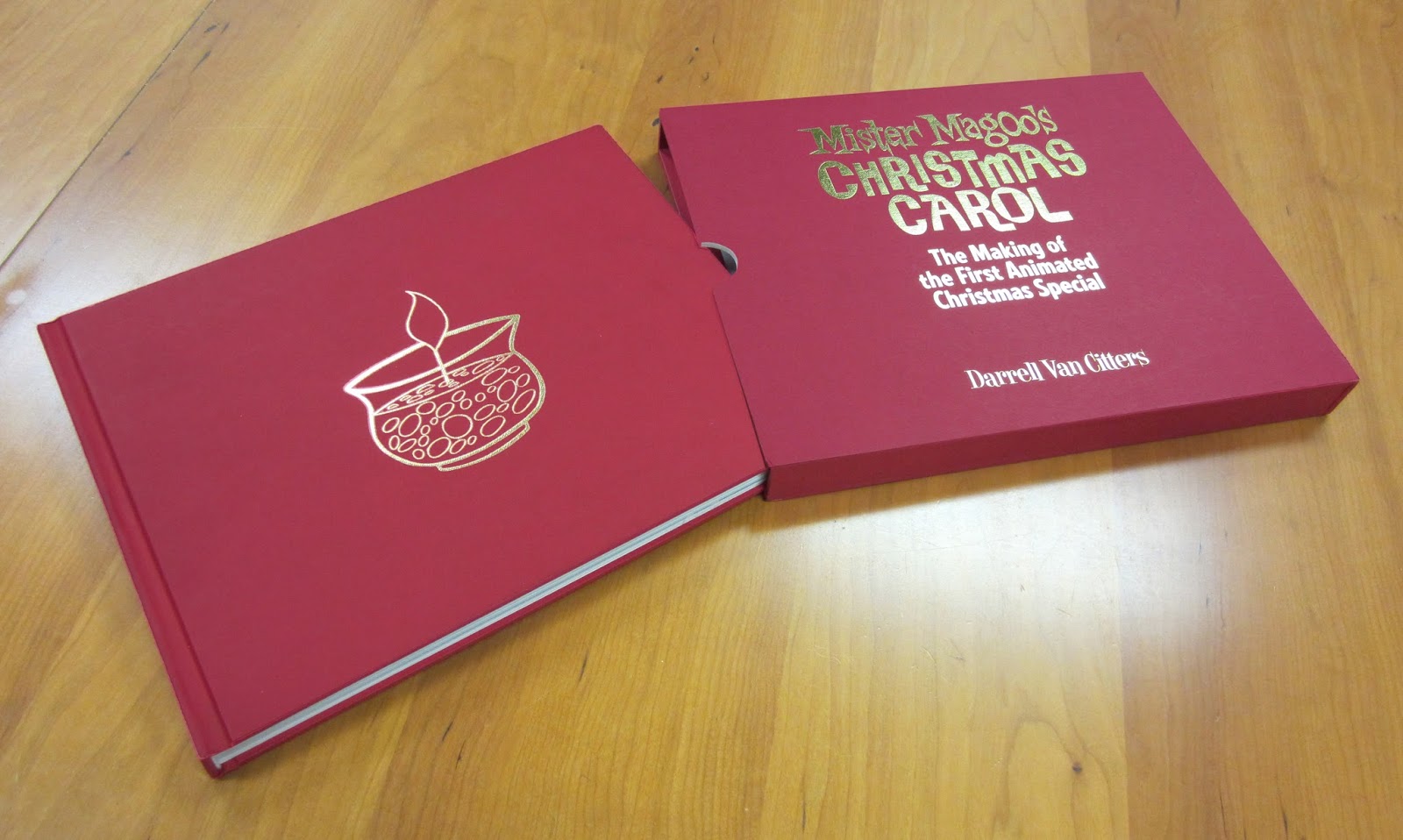
The 50th Anniversary Edition is here!

It's finally here!  Pictured above is the 50th anniversary collector's edition of Mr. Magoo's Christmas Carol, The Making of the First Animated Christmas Special.  For those wondering if they should order this edition, I've decided to answer a few questions on how and why this book came about. 

 Why a 50th anniversary edition of a book that's been out for several years? 

When I first published the book in 2009, I had proposed doing a special edition for the 50th anniversary in 2012 figuring it was several years away.  The first book did better than anyone expected and sold out quickly.  It wasn't in my plans but due to demand, I decided to do a second run with corrections inserted wherever I could.  That edition is on the verge of selling out now. 

In October of last year, a good friend asked me if I was still going to do a 50th book.  I told him it was time to move on but he made it clear he felt something needed to be done to commemorate the 50th anniversary of the special and this might be the only thing to happen.  Not only that, he was willing to put his money where his mouth was.  Although touched, I still wasn't completely convinced.  It was only after I mentioned it to several other interested parties who were also willing to support the project that I agreed to do it.


Isn't this just a ploy to sell the same book three times over?

I'm not that smart.  This is not a money-making venture.  If it weren't for the 'angel investors' mentioned above, this book wouldn't exist.  Those 'angels' have to be paid back from the proceeds of book sales, not an easy task when the print run is so low.  Also, as I mentioned above, there was never supposed to be a second printing and although this edition uses the same format as the previous ones, it has been thoroughly revised and expanded.  It is no easy job to tear apart a book, insert hundreds of images and add text without destroying the narrative and then stitch it all back together. 


Then what's different about this edition as opposed to the previous printings?

 As I mentioned in a previous post, the book has been expanded to 176 pages from the original 128.  There are close to twice as many illustrations now, 435 vs. the original 232, which include: photos which were eliminated from the previous editions due to space restrictions, frames from the re-mastered film when no art could be found to reflect the text, discarded art from deleted sequences which give a glimpse into the production process and a large amount of new production art, most of which was discovered since the last printing.  I had hoped to include some images from Ronald Searle’s illustrations of "A Christmas Carol", showing the influence he had on this production, but the Searle attorneys were dismissive.  Fortunately, Timex was far more cooperative and there are some frames from the original opening credits.  

The book features heavier board and paper stock, printed endpapers, cloth binding in a cloth bound slipcase with gold foil stamping and limited to 250 numbered copies.  


Can I buy this at my local bookstore or on Amazon?

Yes and no.  Book retailers have an unfortunate habit of damaging books somewhere along the supply line; the publisher has to bear the cost of shipping the book to the distributor, having it become damaged and therefore no longer sell-able, and then paying to have the book shipped back.  It makes no sense on a premium book like this to risk that kind of damage and expense.  Although I may make the book available on Amazon, regardless of where you buy it, here or there, it will be coming from me.  It will not be available at your local bookstore.


If you want to order the book, you can get it here.  It's the definitive edition and when it's gone, it's gone.