Mr. Magoo's Christmas Carol

A blog dedicated to the making of the first animated Christmas special, Mr. Magoo's Christmas Carol.
Showing posts with label UPA. Show all posts

Monday, November 16, 2020

Back in print!


 After 8 years of being out of print, I'm pleased to announce that my book on the making of the first animated Christmas special is back in print!  But wait, there's more!  This edition is softcover but instead of reprinting the 2009 book, this is a reprint of the 2012 deluxe slipcased 50th anniversary edition, which had 48 more pages than the original and over 200 more images.  This edition has the added bonus of 2 more pages with 6 more rare photos from the song recording session, photos that were uncovered years after the deluxe edition had sold out.  

To sum up, this printing has 180 pages vs the original edition's 128 pages and 439 images vs 232 in the original.  Because of the limited print run of the deluxe version (only 250 copies), very few people have seen the extra material.  If you only own the first printing, you owe it to yourself to get this version, it's the most complete edition ever printed.  Available online only from the usual suspects like Amazon and Barnes & Noble.

Wednesday, August 19, 2015

Gerard Baldwin, a life in animation


Readers of either of my books, Mr. Magoo's Christmas Carol, The Making of the First Animated Christmas Special or The Art of Jay Ward Productions will instantly recognize the name Gerard Baldwin.  Baldwin was responsible for directing and animating the highly memorable, show-stopping sequence featuring the Despicables in Christmas Carol.   For Jay Ward, he directed and animated many of the best episodes of Fractured Fairy Tales, Aesop & Son and Dudley Do-right at Jay Ward as well as animating several pilots such as Hoppity Hooper, Super Chicken and George of the Jungle.  Baldwin had a flair for turning the limitations of low-budget animation into assets while squeezing out the highest possible entertainment value.


Now, you can learn a little bit more about the master himself in his new book, From Mister Magoo to Papa Smurf, A Memoir by Gerard Baldwin, available at Amazon and Barnes & Noble.  Beginning at his beginning, Baldwin recounts growing up in New York, his decision to become an artist and his sideways move into the medium that would define his career, animation.  You'll read about his early days as an inbetweener at UPA, his military service, his return to UPA and his rise as an animator and director in the TV animation industry, culminating in becoming a producer on Hanna-Barbera's The Smurfs.  Between his stories from the animation trenches and his wry observations, there are a number of charming drawings illustrating anecdotes from his life.


During it's baby boomer heyday, television animation was usually looked down upon, especially by those in the industry.  Consequently, very few animators and directors from that era put their experiences and thoughts down on paper; this is rare insight into the art and commerce of 1960s animated cartoons that is of interest to not only those that grew up with the cartoons but for anyone who follows pop culture.  You can buy it here.

Friday, June 5, 2015

D-Day, 71 years later

Victor Haboush at Disney, photo courtesy of Amid Amidi
Since tomorrow is the 71st anniversary of the D-Day invasion in World War II, it seems appropriate to commemorate the event with this post.  During the research process for Mr. Magoo's Christmas Carol, The Making of the First Animated Christmas Special, I interviewed many artists who had worked at Hank Saperstein's incarnation of UPA in order to get a sense of the studio once it changed hands. One of those was Victor Haboush, an amazing artist and designer who had worked at both Disney and UPA and who could have given fellow Disney designer Walt Peregoy a run for his money as the angriest man in animation (undoubtedly due to the events recounted below). Somehow the conversation turned to his experiences as a sailor on a Landing Craft-Infantry ship on D-Day; even 60 plus years later, the fear was still palpable in his voice as he described his experiences from that day. Below is a transcript of his memories of the D-Day invasion, edited for continuity:

I was just one of these guys that wouldn't tolerate bullshit. I had gone through World War II. I was at Normandy Beach, I landed troops on Normandy Beach. I got out of the service and I didn't want to take any shit from anybody. It just wasn't worth the kind of crap they pulled, they handed out to you.

Soldiers taking cover behind Rommel's hedgehogs
We hit Omaha beach, Easy Red, 30 minutes after H-Hour. Where we were going, there had been a storm and it had washed this real deep gulf, about six feet high, all the soldiers were hiding behind it, and there were iron bars (Rommel's hedgehogs) in the water. They were killing everybody in the water and our guys were trying to get past those things and make it to the other side so they could attack them on the hill. They were just machine gunning the soldiers, it was like a movie. There were bodies in the water. American soldiers floating in the water all over the place because they had machine-gunned them going down (the ramps). It was chaos. I don't think any of them made it on shore. We barely made it off the beach.

Landing Craft-Infantry, Haboush would have been in the rear conning tower
We started hitting it and we took a German 88 right in our steering engine room. Then the shrapnel went down and killed one of the guys who was coming up the steps and the other two were blown to bits, there was nothing left of them. The 4th guy I don't know where he was. My little landing craft, we were 30 people, 10 were injured and 4 were killed. We lost our left ramp. You had these 2 ramps on Landing Craft Infantry; when you hit the beach, these iron arms go out with cable on them and drop 2 ramps on each side. The soldiers go down on both. We had about 200 soldiers on board that we were letting off.  There was a small Landing Craft-Personnel, LCP, up next to us and the guy yelled up for a line so he could get up. He was going in to catch the line and he was shot right off that thing. It was like he was never there, it was a strange thing.

My station was up with the old man. I was on earphones with the skipper and he would give the orders. You know, 3 forward, 4 back, reverse, all that stuff. I would repeat it in the phone. Thank God I didn't have to get off, I wouldn't be here today. I was right on the conning tower with the skipper right next to me. I had this huge helmet on and I had these earphones under it. I had that helmet up right down my forehead and I could just see 2 inches out of it. I had a perfect seat for that whole thing. I could watch the whole thing going on.

We pulled (D-Day photographer) Robert Capa off the beach. He wrote (to me), telling me my picture was in Life magazine. You would never know it because you just see a piece of me, my helmet and little bit of my big nose. There was this one kid (in the picture) who died just a few minutes after I was holding a big compress on him. Anyway it was in Life Magazine.

This appears to be the photo he describes above.

One of Robert Capa's iconic D-Day invasion photographs
After we landed infantry, we finally got off (the beach) after we got hit. Then we went back and dropped Capa off at one of the ships. He said that our ship sunk when we dropped him off, which is not true. He just totally lied about it, he said he got on the ship and the captain was crying. The first mate had been blown up and blood was everywhere. That was all bullshit. He came on board though. I had to laugh. It was bad enough, he didn’t have to exaggerate. That is how he gained his reputation. He was a brave guy, he went in on the first wave. He stood by those iron things (Rommel's hedgehogs) and he took those pictures. There is nothing cowardly about the guy. But why he would make up a story, I will never know. I guess that was his art form.

We lost that one ramp when we got out there. I was just so happy to get off the beach finally, we were there way too long. We got these orders that we were to pick up these 2, a little bigger than an LCP. It was another landing craft. I think it had about 80 guys on there, they were Seabee's [C.B., slang for Construction Battalion] and they were going to put them on the beach so they all came on our ship. My new station was at the front of the ship and we were headed in there again. I got to tell you, this time I was scared shitless. I was up there with my little friend, we called him Murphy, his name was George Weisberg and we were cussing the skipper out and calling him all kinds of names, ‘You glory happy son of a bitch, turn around you are going to get us all killed!' He was steaming in there with only one ramp. Our radio broke down, it was chaos. The only way to communicate with each other, we had these radio boards with all these wires, they would cut us off and so we'd go back. 'Another ship will take it in, we heard you lost your left ramp.' The skipper said 'Yeah.' The skipper was going to go in and boy we were so relieved. So we let the guys off on another ship, a different one. That was like getting a pardon.

Afterwards, when we finally got off the beach, I was the only one on my ship that could clean those guys up. I was picking them up. We put blankets in these wire things you carry people in and I was scraping them up with a scraper and dumping their bones and everything in there. Nobody else could do it. All I did was think about my Dad's meat market and cleaning off the butcher block. It was really quite something, I think it really has affected me for a lot of years after.  


Amid Amidi's Cartoon Brew has more on Victor Haboush's life here.

Thursday, March 19, 2015

Commercials at UPA

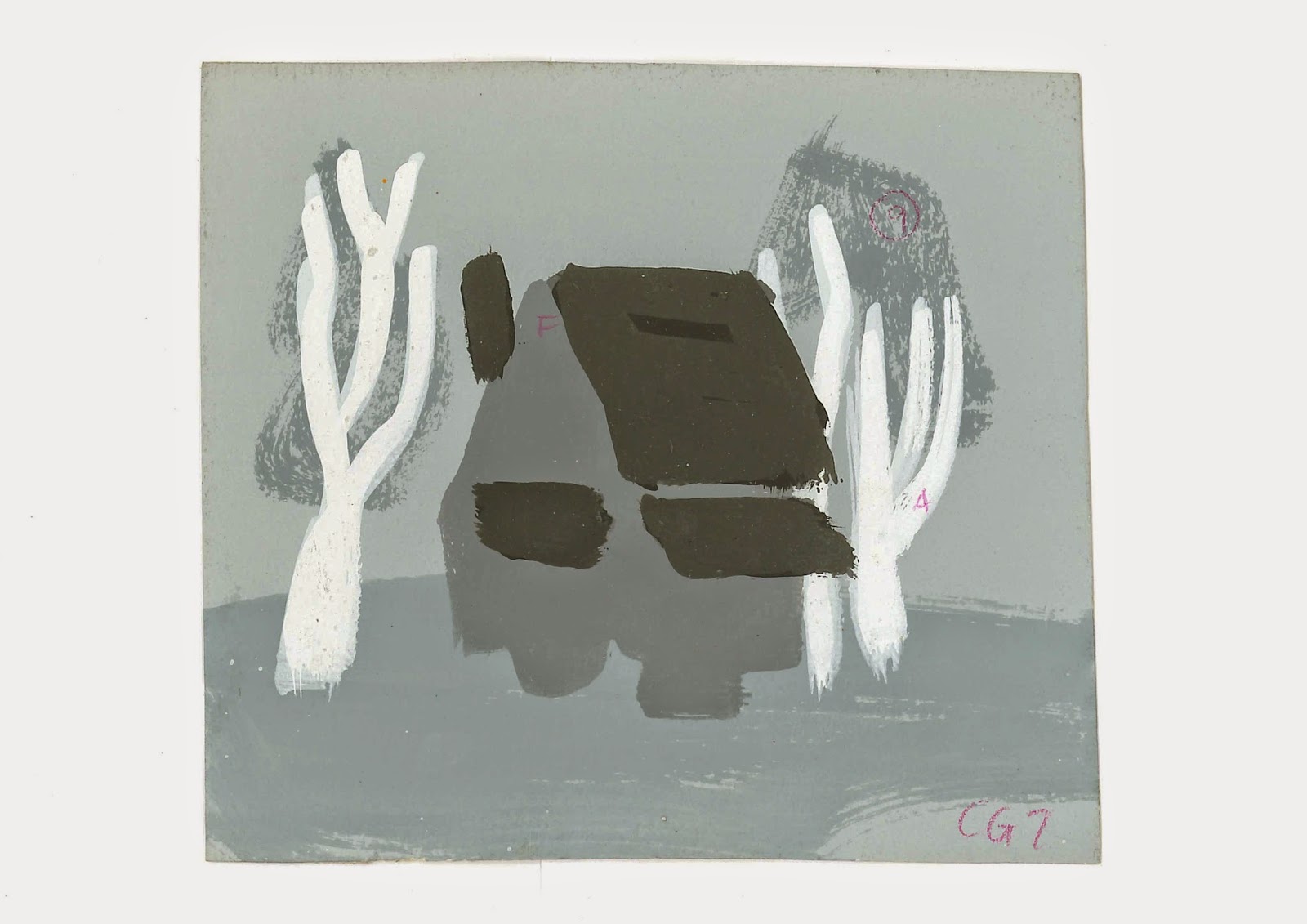
My last post featured Sam Clayberger's color work at UPA for some of the theatrical Magoo cartoons.  Concurrent with those shorts, UPA was also producing a high volume of television commercials and in fact, that division was the only one making money for the studio. 

Due to the technology of the time, i. e. black & white TV, the spots were executed in shades of gray rather than color.  While it might appear simpler to paint in a monochromatic medium, the challenge is in making your values read crisply so items don't blend into the background.  Below are few of the thumbnails painted by Sam for some of the myriad commercials done during his time at UPA.  Vintage B & W TV ads are difficult to find so none of these have been identified as of yet.  If anyone can ID the spots these are from, please let me know.


Thursday, March 12, 2015

Sam Clayberger, designer at UPA

Sam Clayberger painting at UPA
I first met designer and painter Sam Clayberger as part of my research for my book, The Art of Jay Ward Productions.  As it eventually turned out, Sam became quite a resource for art for that book, having been Ward's principal background painter for most of the Ward studio's history.

Readers of my book may recall that most of Jay Ward's staff came from UPA after having left the studio as it was collapsing in 1959.  While many of the directors at Ward were already old pros by the time they arrived at UPA, most of what would become the design crew at Jay Ward Productions were recent grads of the LA art schools.  A prime example of that was Sam Clayberger who, sometime after graduating from Chouinard Art Institute, got a phone call from Chouinard instructor Don Graham informing him of a short term  opportunity at UPA moving desks.  Sam took the gig and parlayed that "quickie" into a full time job doing layout and later background painting.  He left employment at UPA after a few years in order to paint but kept money coming in as a freelancer first at Hanna-Barbera in their early days and later working for Ward as a full-time freelancer so he could continue to paint, later adding teaching at Otis Art Institute into his already full schedule.

Sam recently came across a small stack of his color thumbnails from his brief time at UPA where he worked on a number of Mr. Magoo cartoons, some of which are reproduced here for your enjoyment.  First up, Magoo's Cruise from 1958, in which Magoo arrives on a pier for a reunion cruise with old friends but is mistakenly taken on board what appears to be a Soviet submarine. Sam is credited with design and color, which would mean he designed and laid out the backgrounds as well as keying and painting them.  (Brief footnote here, one of the animators on each of the shorts listed here was Casey Onaitis, who animated on Mr. Magoo's Christmas Carol.)  The last image is an actual production background of the interior of the submarine.


Next, 1957's Magoo's Private War, in which he is credited for design (layout) and co-credited with Ervin Kaplan for color.  The color styling was all Sam's making it likely that Erv followed up on the backgrounds.  In the cartoon, Magoo mistakes a theatrical war film for an invasion and tries to calm the audience, telling them that "General Clayberger" will be coming to save them.  Most of the beginning shots are painted quite hot in contrast to the bulk of the film which takes place in either a darkened theater or on nighttime city streets.  The currently available transfer of this film is on the murky side in comparison to these color keys.


Finally, Merry Minstrel Magoo from 1958 wherein Magoo heads down to a TV station to audition for a talent show; Sam is credited with both design (layout) and color:


Unfortunately, these cartoons are not available online so if you'd like to see them to compare them to Sam's originals, you'll have to pick up the boxed set from The Shout Factory which is available here on Amazon.  Up next will be some of Sam's keys for black & white UPA commercials.  On March 23rd, be sure to check out my Jay Ward blog here for some examples of Sam's beautiful color keys for Jay Ward.

Monday, October 20, 2014

Pitching The Famous Adventures of Mr. Magoo

Pitch art for Robin Hood, artist unknown
My last post, Mr. Magoo and the Features That Never Were, featured some rare UPA pitch art for the studio's unproduced Mr. Magoo features.  Considering the lineage between the feature concepts and the concept for the 1964 TV series, The Famous Adventures of Mr. Magoo, it seemed only fitting to do a post on the artwork produced to pitch the show to NBC.


Pitch art for William Tell, possibly drawn by Bob Dranko


The 1962 broadcast debut of Mr. Magoo's Christmas Carol had performed well beyond expectations and the network was looking for a followup.  The special had featured Magoo playing a role in a piece of classic literature and considering that all of UPA's previous proposed feature vehicles had done the same, Robin Hood, Don Quixote and 1001 Arabian Nights, it was not a big leap to suggest an entire series based around the premise.  Hank Saperstein was a consummate salesman but despite his skills, he still needed some visuals to clinch the deal.  It was most likely Lee Orgel that put together the art that sold the series, turning to Shirley Silvey, who was on layoff from Jay Ward at the time, and Corny Cole, who had produced the concept art that had previously sold Christmas Carol.

Pitch art by Corny Cole
How many drawings were done by Corny Cole is unknown but about half a dozen have surfaced.  It appears that Shirley did a much larger number of images for a wide variety of stories, although most of the original drawings and setups have been lost.  Below is a scan of many of her pieces that were photographed for early promotion, this image is from a brochure sent to NBC affiliates.


When I was going through the boxes of her surviving artwork, I found photocopies of a few of her thumbnails; it's possible that some of these were never taken to full-sized color artwork.  The quality is poor so click on them to enlarge:

 
Captain Kidd

Don Quixote


Treasure Island


The final rendering for the left thumbnail for "Treasure Island" is reproduced in the pamphlet image above.  Recently discovered in Ray Bradbury's collection, and sold at auction, was the following piece of pitch art for Famous Adventures, also by Shirley Silvey.  The background is done with cut paper and colored pencil:


The setup below, which was reproduced in my book, was listed as artist unknown.  Looking at the breadth of the art done by Shirley as well as her drawing style and the use of cut-out background elements and color pencil, it appears that this piece can now be attributed to her.


Special thanks once again to the Mago0 Admirer for the idea behind this post.

Monday, October 13, 2014

Mr. Magoo and The Features That Never Were

Those who read this blog or who are up on their animation history will know that Mr. Magoo starred in an animated feature, the 1959 release, 1001 Arabian Nights.  But how many are aware that it was not the only vehicle considered for a Magoo feature?  As with most of film production, there are fits, starts and even different directions taken before arriving at the final destination.  So it was with Mr. Magoo and his feature career.

The UPA studio had built their reputation in animation on three things--contemporary art, contemporary situations and the use of human characters, rather than animals, to tell their stories.  It was a deliberate rejection of Walt Disney's approach to the medium but when they began to contemplate producing a feature, they unconsciously followed Disney's lead when it came to subject matter.  All of their proposed features involved non-contemporary or mythical settings and several went back to classic literature.  The first to be generate much pre-production work was based on James Thurber's 1945 children's fairy tale, The White Deer.  Although the story dealt with something that had become Disney's stock-in-trade, the fairy tale, the studio was quite excited about adapting the work of a contemporary artist like James Thurber.

But it was not to be.  It wasn't long before Columbia, UPA's distributor, let it be known that they would feel much more comfortable if the studio built a film around the highly popular character of Mr. Magoo.  Seeing the Golden Rule in play here--he who has the gold, makes the rules--UPA acquiesced and announced a feature version of Miguel Cervantes' classic novel, Don Quixote of La Mancha with Mr. Magoo in the title role.  Although development work was done on the project, Columbia had subsequently entered into an agreement with a Spanish producer to do a live-action film of the novel and sidelined the animated version.

 
Pitch art for Don Quixote, artist unknown.

To take its place, two other Magoo vehicles were developed, Robin Hood and 1001 Arabian Nights.  When it came time to pick between the two, studio head Stephen Bosustow chose 1001.  Jim Backus was aware of the Robin Hood project and in an interview promoting 1001, he provided a small peek behind the scenes, saying  "We used to talk and we thought Magoo would be funny in ... maybe  Don Quixote.  He would be wonderful ... because he is tilting (at) windmills and we finally, I think, hit upon the one universal character, the Aladdin theme of the Arabian Nights. So it's the first feature  and I hope not the last. We are also toying with doing Robin Hood ... (Magoo) as Robin Hood ... which would be kind of funny, I would think."   

However, the box office failure of 1001 Arabian Nights doomed the notion of any future Magoo features and so decimated the studio's finances that shortly thereafter Bosustow sold UPA to Hank Saperstein.  The concept of a Magoo/Robin Hood theatrical feature was lost in the mists of time until a few years ago when a few pieces of the pre-production art for the film first surfaced:


Although a theatrical feature was never produced, "Robin Hood" did later see life as a virtual feature length production,  covering a span of 4 episodes for The Famous Adventures of Mr. Magoo just five years later.  This time, though, Magoo was no longer playing the role of the title character and was recast as Friar Tuck.  Saperstein later edited the four half hours into a complete story and released it theatrically and later the same way on home video.  Which leads to an interesting conjecture--was a script written for the proposed feature and did it serve as the basis for the four part TV episode?  Saperstein was known for maximizing his return on investment so the idea of recycling an unproduced script would not be far fetched.  And innterestingly enough, "Don Quixote" was the only other Famous Adventure to last more than one episode--was this another example of salvaging material from UPA's proposed features?  With so little of either the pre- or post-Saperstein UPA archives available, we will probably never know. 

Lee Mishkin's models for the four part Robin Hood episode


To read more about UPA's foray into feature films, check out Adam Abraham's essential history of the UPA studio, When Magoo Flew.  Special thanks to the Mago0 Admirer for his assistance on this post.

Monday, August 18, 2014

David Weidman 1921-2014


By now, most of you will have heard of the passing of David Weidman, who painted backgrounds on Mr. Magoo's Christmas Carol, did color styling on numerous Fractured Fairy Tales and also painted for Hanna Barbera in the late 60s.  He was even more well-known for his serigraphs from the mid-60s to the 70s, some of which can be seen here.  I profiled David about 3 years ago, which you can see here and if you're interested in reading more about David Weidman, check out his book here.

Unfortunately, he passed away while I was out of town, hence this late posting.  David died peacefully and in the home he built.  His memorial service was yesterday and family members and friends celebrated his life, recounting his sense of humor and unique, iconoclastic approach to life.  He lived a long life, long enough that he was around when his work was rediscovered late in life.  In fact, some of his serigraphs could be seen in episodes of Mad Men, as you can see here. 

I always found my visits with David to be humorous, stimulating and informative.  My last big visit with him was during research for the Jay Ward book, when we discussed his work for TV Spots, a Ward subcontractor, on Fractured Fairy Tales.  Although that part of his career had been largely overlooked, even by him, he was a font of knowledge about his time there and why he did what he did.  It was as if we had opened up a long forgotten closet and the information just came tumbling out.  Because the shorts he art directed there are so visually arresting, I ended up devoting several pages to his work.  Here's an example below:

It was an honor to have become a friend of David Weidman as well as chronicler of his animation work. Good-bye David, your keen eye for design and your wonderful sense of humor will be missed.