Mr. Magoo's Christmas Carol

A blog dedicated to the making of the first animated Christmas special, Mr. Magoo's Christmas Carol.
Showing posts with label Henry G. Saperstein. Show all posts

Monday, December 1, 2014

Mr. Magoo's Christmas Carol, revisited


As the Christmas season is upon us, it seems only fitting that I should start out the month of December with a new post sharing some recent discoveries from Mr. Magoo's Christmas Carol

I learned many things researching, writing and publishing three editions of my book on the making of the classic special, but perhaps the most salient thing I learned is that no book is ever complete.  When I put together the 50th anniversary edition, I did everything I could to make it the most complete version of the book using new information, artwork and photos.  After 5 years with the material, it seemed like anything waiting to be discovered had already been found.  And for a couple of years I was right.

However, life is never that simple.  When Lea Orgel, widow of producer and MMCC creator Lee Orgel, needed to move into an assisted living facility because of declining health, I was asked by her daughter, JoAnn, to help her dig through a lifetime's worth of boxes in Lea's storage unit.  We went through all the boxes pertaining to Lee's career in entertainment but found nothing of significance regarding the Christmas special.

Three months ago, JoAnn called me asking me to take a look at several boxes she had discovered that had been marked in such a way as to mislead us as to the nature of their contents.  Because we had already gone through so many boxes, I assumed that what was in these boxes was most likely material from Lee Orgel's later career, and my assumption proved to be largely correct.  There were stacks of art from the mid-60s to the mid-70s, most of it drawn by Corny Cole, everything from The New Three Stooges to a variety of ABC After School Specials, from unproduced pilots to prime time animated specials.  One pilot, the Morey Amsterdam-produced Black, Cloke and Dagga, was the subject of a previous post on Cartoon Research.  (Images from the other projects will be posted in a future blog entry.)

But the most amazing find was hidden in a letter-sized box, which appeared to contain merely a 2" stack of photos from Lee Orgel's Capitol Theater days, signed 8 x 10s from famous and obscure singers and musicians who performed at the theater.  The images were fascinating as a time capsule but also interesting to see well-known performers like Doris Day as they were in the 40s.  However, in the middle of that stack of photos were fifteen 4 x 4" photos taken during the song recording session for Mr. Magoo's Christmas Carol!  Photos that hadn't been seen since they were taken and had never before been published, photos that I would have loved to have included in the 50th anniversary edition, photos that gave just a tiny bit more insight into that historic day.

As there are no plans to do another edition of the Magoo book, I have decided to post the photos here.  For the first time in 52 years, here are the long lost images:

Jule Styne with Jane Kean, the biggest find in the batch.

Production manager Earl Jonas talks with Hank Saperstein while Jim Backus reads the trades.


Lee Orgel confers with Jim Backus.

Jim Backus chats with Hank Saperstein.


Paul Frees with Jule Styne.  In the background are Royal Dano, left, and Earl Jonas, right.

Walter Scharf conducts a rehearsal as Backus listens.


Monday, October 1, 2012

Mr. Magoo and UPA


Last January, I mentioned that there would be several Magoo related items being released this year.  The first was the seminal history on the UPA studio, When Magoo Flew, by Adam Abraham.  It tells the story of the unique studio that revolutionized animation design but was plagued by indecision, weak stories and poor production management, all of which eventually did it in.  While the studio eschewed what it felt were the rigid formulas of the other studios' output, UPA was no less rigid in it's ideological viewpoint; any mention of Warner Bros. cartoons, for example, was strictly verboten.  Bill Scott, head writer for Jay Ward, who wrote for both Warner Bros. and UPA, concurred:  "To begin with, you never mentioned Warner Bros.!  The kiss of death at UPA was to be considered a Warner Bros. writer."  Gerard Baldwin, in his upcoming autobiography, recalls how Chuck Jones, who had directed an early UPA effort, Hell Bent for Election, eagerly screened his first Roadrunner film, Fast and Furryous, for the UPA artists to deafening silence.  The audience filed out silently and Jones slunk back to his car, alone, film in hand.  It also appears to have been a studio not for the faint of heart, at least if you were in the top echelon of artists.  While the artists were outspoken in their opinions of the other animation studios of the time, they reserved the long knives for themselves , often turning on each other through political jockeying and power plays.  Many consider Hank Saperstein’s ruthless takeover of the company as the destruction of a once great enterprise but this book makes it clear that the foundation for its demise was in place long before then.  Highly recommended.


Another new release for this year was the UPA boxed set, a retrospective of all the studio’s non-Magoo cartoons (although it does include Magoo’s first cartoon, The Ragtime Bear).  The UPA library has been difficult to find on video and no complete collection of the studio’s cartoons has ever been released before.  The set is a great companion piece to Abraham’s book as it provides a visual counterpart to his text and illustrates both the strengths and weaknesses of the studio’s theatrical output and makes it clear that UPA's reputation was made off of a surprisingly small group of films.  Despite this, the studio's impact on animation design continues to reverberate today.  Most of the transfers are gorgeous, allowing a viewer to better comprehend the design and color that made the studio so renown.


Last but not least was a boxed set of the complete theatrical Magoo cartoons including his feature debut, 1001 Arabian Nights, which has been long out of print.  Unfortunately, this set, which was scheduled for release first in February, then June and finally December, has been pushed back yet again and will not be released until sometime next year.  The good news is that the delay is due to the fact that all the cartoons are being digitally remastered from the original negatives and it’s taking Sony longer than originally anticipated. However, if the UPA boxed set is any indication, it will be worth the wait.  I will update this blog when there is more news to report on the collection.


Thursday, November 4, 2010

Coda

Part four of a four part series

     In the years immediately following his departure from the studio, Stephen Bosustow was prohibited from producing in the Los Angeles animation industry due to a non-compete clause in his contract with UPA.  He spent the next few years in Hong Kong, helping a faltering animation studio and trying to drum up work for them from the US.  On his return to the states, he began consulting for an educational film company, Film Associates, and eventually segued into producing educationals for them under his own label, Stephen Bosustow Productions.  Several Christmas Carol alums worked with him in those later years including Sam Weiss and Lee Mishkin, who directed the 1970 Academy Award winning animated short, Is It Always Right to Be Right? produced by Bosustow’s son, Nick.  Mishkin left soon after that and Sam Weiss took his place, directing most of the studio’s later output.  In the mid-70s, Bosustow Entertainment was formed to produce ABC After School Specials, Sesame Street animated inserts and work for other television clients.  Stephen Bosustow died of pneumonia July 4, 1981 at the age of 69.  Four years later, his son Nick closed down the studio.


     UPA continued on for several decades but largely as a distribution and licensing organization.  When animation was needed, usually for television commercials, it was farmed out to ex-UPA staffers and vendors.  In later years, former UPA production coordinator, Paul Carlson, would produce the commercials under the banner of the eponymous Paul Carlson Cartoons.
     Saperstein closed the studio in 1983 and continued to live off the income generated by his diverse portfolio of licensable properties.  He occasionally tried to sell off those assets, either in part or as a whole, but could never come to an agreement with potential suitors.  The John Lautner-designed studio facility was razed when it was sold that same year, ironically enough, to Walt Disney’s nephew, Roy E. Disney, who built the headquarters for his company, Shamrock Holdings, on the property.
     In June of 1998, Henry Saperstein passed away from cancer.  His widow, Irene, sold the UPA assets to Classic Media in 2000, finally ending the story of the controversial and once highly regarded studio.

     As a footnote, it should be mentioned that Stephen Bosustow did not like Mr. Magoo’s Christmas Carol.  He felt that the concept of Magoo as actor had been tried once before in 1001 Arabian Nights and didn’t work.  While that may be a technically accurate assessment, it’s questionable as to whether any audience saw Magoo as an actor in a role in that film.  Bosustow’s opinion was likely colored by the high profile failure of the feature that he had hoped would save his company.  It's also not inconceivable that any good fortune Saperstein had with UPA would have been a bitter pill for Bosustow to swallow.  Ironically, the Christmas special became one of UPA’s most financially successful properties.

Thursday, October 28, 2010

Bosustow vs. Saperstein

Third in a four part series
     Due to the new distribution agreement with Hank Saperstein's company, Television Personalities, production demands at UPA skyrocketed.  It was ironic that the studio that had pioneered the limited animation technique as an artistic choice was now consumed by it as an economic necessity.  Artists at the time, though, were grateful for the work since the entire animation industry was in a state of turmoil over the collapse of the theatrical market. 

     Stephen Bosustow, although still at the studio, was nowhere to be seen.   The Magoo and Tracy TV shorts were flying through the studio and a new feature (Gay Purr-ee) was in active development, none of which involved Bosustow’s participation.  As part of his contract with Saperstein, he had been given an office at the studio and encouraged to develop new ideas and properties for UPA.  However on July 10, 1961, a special meeting of the UPA Board of Directors was called; present at the meeting were four directors, M. J. Saperstein, Harold Bell, Stephen Bosustow and Hank Saperstein, who served as chairman of the meeting.  Minutes from the meeting indicate that 78 personnel had been laid off over the last year, with most of those coming as production on the TV shorts ceased.  Saperstein claimed, that in spite of the extreme production demands on those shorts, the studio had been overstaffed when he took over and he asked to be empowered to make further cutbacks as he deemed necessary to maintain the financial health of the corporation.  The motion carried unanimously.

     The very next resolution by Saperstein stated that of all the projects and ideas that Stephen Bosustow had come up with over the last year, “none of the ideas or projects were determined to be practicable or within the scope of the corporation’s activities or its finances.”  As a result, the studio “could not continue the payment to Mr. Bosustow of a salary and substantial expense allowance.”  Bosustow dissented, probably vociferously, but Saperstein had the majority and the motion carried.  His salary and expense allowance were deferred until further order of the Board of Directors.  Bosustow had just moments before, unknowingly, given Saperstein permission to effectively eliminate his position in order “to maintain the financial health of the corporation”.  It seems fair to say that Bosustow had been blindsided by Saperstein’s machinations and five days later, all payments to Stephen Bosustow ceased.  Bosustow immediately threatened to sue, to which Hank reportedly replied, “Well, go ahead but you’ll have to get to the end of the line.” (viii)  

    On July 15, Stephen Bosustow, seeing no other options, left the company he had co-founded and helped to build.  A breach of contract lawsuit and writs of attachment were filed in Los Angeles Superior Court on October 13, 1961.  Listed as defendants, were Henry Saperstein, Peter DeMet, UPA Pictures, Inc., Television Personalities, Inc. and seven “Doe” corporations (ix), all alleged to be controlled by Saperstein and the identities of which were unknown to the plaintiff.  The allegations were many and covered everything from compensation and Bosustow’s creative role to deception and outright fraud on the part of the defendants.  Probably the most salient allegation regarding his departure was that Saperstein had deliberately sidelined Bosustow and told him that he never had any intention of using him in a creative capacity.  He further alleged that he had been told the hope was that he would abandon the agreement out of discouragement.  The fraud allegations concerned the movement of assets to Saperstein’s myriad corporations to avoid fiscal responsibility, forcing UPA Pictures to plead poverty (xi).  The financial loss was listed as approximately $346,000 while the damages requested totaled $1,000,000.

     Stephen Bosustow’s departure was the final break with the old UPA.  Most of the original staffers had left in 1959 and Bosustow himself had not been involved in any meaningful capacity at the studio for at least a year.  His sudden absence barely registered with the staff.  In addition, all eyes in the studio were now focused on their next big project, the feature length Gay Purr-ee.

           Stephen Bosustow had hoped that the hiring of his original law firm, Charles J. Katz, which was known for its fierce reputation, would induce Saperstein to settle.  He didn’t and Bosustow eventually hired a new firm.  It appears that Saperstein’s legal representation was adept at grinding down the opposition, both emotionally and financially.  For Bosustow to prove his case, his legal team had to unravel the financial dealings between each one of Saperstein’s many companies, as well as how they interacted with UPA.  Even clients and sponsors were deposed in the process. The legal actions dragged on for years as Saperstein’s counsel engaged in numerous delaying tactics filing procedural motions every step of the way.  

     It took him five years but Bosustow did finally achieve some satisfaction in his lawsuit with Henry G. Saperstein, although at a considerable expenditure of time and money.  Just as the suit was about to go to trial in September of 1966, Saperstein reached a settlement with Bosustow agreeing to pay him $125,000 over five years, considerably less than $1,346,000 in losses and damages that had been requested, especially once inflation was factored in. Over the ensuing years, Bosustow incurred further legal costs when Saperstein’s periodic payments were late.  The entire process, from the filing of the initial lawsuit to the final receipt of payment, took ten years.

(viii)The Tip of the Iceberg: A Conversation with Lee Mishkin by Leslie Bishko, FPS Magazine.
(ix) In a 1965 lawsuit by Thorton Sargent, Sargent vs. Saperstein, the plaintiff listed 50 “Doe” corporations as being pertinent to his case.
(x) It was later determined that Saperstein received business loans through Television Personalities, Inc. and then loaned the same money to UPA at a much higher interest rate. The diversion of funds to interest payments apparently helped to deplete UPA’s finances.

Next Thursday, Coda

Thursday, October 21, 2010

A New Direction

Second in a four part series
     Henry G. Saperstein, or Hank, as he was commonly known, got his start in the entertainment industry when he inherited a small string of Chicago theaters at the age of twenty five.  At some point, the theaters were sold and Saperstein became involved with fellow Chicagoan, Peter DeMet, whose family owned the DeMet’s Candy Co.  DeMet had created the sports show, Championship Bowling, which Saperstein helped him package for network broadcast.  Hank had been quite successful in Chicago but there was a lot more money to be made in Hollywood, where most of the properties available for packaging and licensing were being produced so he moved west.  By the late 1950s, Saperstein would have a hand in merchandising Elvis Presley, Wyatt Earp, Lassie, The Lone Ranger, Roy Rogers, The Rifleman, The Three Stooges and last but not least, manufacturing and providing the premiums for Kellogg’s Corn Flakes.  It was a diversified portfolio and due in part to tax regulations at the time, Hank Saperstein set up a separate company for each property to administer the licensing or manufacturing.  Ultimately, the companies would number in the dozens.  Those myriad companies would be important to UPA’s fate.

     Saperstein knew Mr. Magoo was a relatively unexploited character and was a good fit for his licensing business.  Sensing an opportunity due to UPA's financial straits, he called up and met with Stephen Bosustow to discuss a proposal for his star property, Mr. Magoo.  Sometime later, on December 31, 1959, an agreement was signed between Bosustow’s UPA and Saperstein’s Television Personalities, Inc. for UPA to produce 130 Mr. Magoo shorts to be distributed by Television Personalities.  Production on the made-for-TV shorts was begun early in 1960, initially under the auspices of Stephen Bosustow.  Shortly after the deal for the Magoo show, Saperstein, making use of his Chicago roots, approached Chester Gould and his syndicate, The Chicago Daily Tribune, with the idea of producing Dick Tracy in animation.  Gould made a visit to the studio and an agreement for 130 Dick Tracy shorts was soon in place.

The studio had been looking into the abyss at the end of 1001 Arabian Nights fearing a lack of production but was now facing a workload larger than anything it had ever seen.  Hank Saperstein had opened the spigot.  In its theatrical heyday, UPA had been turning out a six minute cartoon at the rate of one every five weeks.  Now it would turn out a five minute cartoon every five days.  (It appears that Vice President Herb Klynn, et al., wanted no part of this new direction for the company which would explain why they left before the debut of the feature.  Ironically, their new series, The Alvin Show, had to be produced on an equally time- and budget-constricted basis.)

     As part of their initial business meetings, Saperstein and Bosustow met for lunches, probably at The Smokehouse, the restaurant next door to the studio.  The pressures of running a studio had become overwhelming and Bosustow was looking for a way to get out of it and back into producing.  One day at lunch, he casually mentioned to Saperstein that he was in the process of selling UPA, having signed an agreement on December 22, 1959 for the sale of UPA stock to a group of buyers, Seymour Weintraub & Associates.  Saperstein, seeing the licensing value in the Magoo character, and being a consummate salesman, immediately made him a far more generous offer (iv).  In fact, the first draft of the sales agreement between Saperstein and Bosustow made it clear that Mr. Magoo was “one of the fundamental considerations” in Saperstein’s purchase of the company.  (It also seems likely that Saperstein tendered his offer to protect his distribution agreement for the Magoo TV shorts.)

     Saperstein had cannily sized up his seller’s situation and with only a few pieces of paper, promised to relieve him of all his burdens.  Hank’s offer answered every single one of Bosustow’s concerns, including his liability for backing out of his agreement with Weintraub and Associates (v).  Stephen quickly took him up on it and although there were other stock holders who needed to be bought out, Bosustow was the majority owner and a deal was agreed to.   It was an attractive deal on paper, considering that all that was being sold was a production facility and the rights to two well known characters, Mr. Magoo and Gerald McBoing Boing, in exchange for financial security.  There were no other assets as the film library had long since been sold back to Columbia as each film had gone over budget (vi).
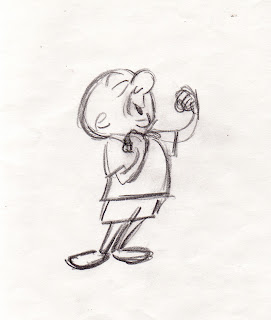
     As part of his distribution plan, Saperstein approached the Kellogg Company, for whom he had been doing cereal premiums, with the prospect of sponsoring a half hour show featuring the new Mr. Magoo cartoons (Left, rough drawing from a Kellogg's Rice Krispies commercial).  Kellogg was already sponsoring the Huckleberry Hound and Woody Woodpecker shows but was eager to advance their dominance in the lucrative cereal market so they directed their advertising agency, Leo Burnett, to move forward.  A Letter of Intent was signed on May 18, 1960 between Burnett and Television Personalities on behalf of UPA.

     With the agreement in place, Hank next tapped his Chicago connections, Peter DeMet, and La Salle National Bank of Chicago to finance the purchase of UPA.  Having Kellogg on board as the sponsor made the sale quite attractive for the bank and they agreed to help finance the deal; Hank claimed in later years that he personally never put any money down (vii).  The terms of the deal had Bosustow selling the company to Henry Saperstein, Peter DeMet and Television Personalities, Inc. and he was paid $15,000 as a down payment for his stock in UPA with the balance ($58,500) to be paid over time.  It allowed him to continue on as an employee with a salary and expenses on an exclusive basis for five years and on a non-exclusive basis for another five.  He was also encouraged to develop new properties for which he would share 5% of the net profits. 

     The agreement was signed on June 27, 1960 and with it, the UPA once seen as an artistic utopia ceased to exist.  In its place was a licensing company with a production arm.

(iv) Stephen Bosustow interview with Michael Barrier, November 30, 1973 
(v) Weintraub & Associates did file suit against Stephen Bosustow on February, 17, 1961 but the case was closed May 11, 1962 so apparently some kind of settlement was reached. 
(vi) Interestingly enough, Saperstein began buying back the UPA shorts in 1960 but it appears that he might have only been buying back the McBoing Boing shorts.  There were plans to make The UPA Cartoon Show, to be distributed on CBS but it was later listed as being abandoned. 
(vii) Interview with Paul Carlson, May 21, 2007

Next Thursday, Bosustow vs. Saperstein

Thursday, October 14, 2010

A Studio on the Edge

First in a four part series

      How did UPA, the animation studio once regarded as the pinnacle of artistic animation, end up as a factory for TV animation?  Rumors and half truths about what actually happened circulated within the animation industry for so many years that they became conventional wisdom.  Unfortunately, the conventional wisdom contained some disparities and it became a question that I felt needed an answer as I delved deeper into the story of the UPA studio and Mr. Magoo’s Christmas Carol.  To answer that question, it was necessary to examine over a thousand pages of documents in the Los Angeles County Superior Court records.
      In the original draft for the book, I had posited that four people were responsible for the production of Mr. Magoo’s Christmas Carol-UPA studio chief Stephen Bosustow, executive producer Hank Saperstein, producer Lee Orgel and director Abe Levitow.  Although Bosustow had not been involved with the actual production of the special, decisions he had made years earlier created the situation that eventually led to the film’s existence.  During the book rewriting process, it was determined that those actions “behind the curtain” were not germane to the story of the making of the film and the material was excised. 
      However, I felt it was a fascinating insight into the clash of business and art, not to mention the clash of wills and have chosen to make it available to others as a cautionary tale about the business side of art.


Trouble in paradise 
     As the decade of the 1950s came to an end, there were a number of elements which conspired to challenge the future of the UPA studio, not the least of which was the market for theatrical animated cartoon shorts was rapidly disappearing.   Television had been making inroads into the animation industry and that trend had begun to accelerate in the late 1950s.  The collapse of the theatrical market during that period had essentially closed that revenue stream to UPA.  As devastating as that loss was, it may have been a mixed blessing as the shorts were a financial drain for the studio, being consistently and chronically over budget.
     What paid for the over budget shorts was UPA’s television commercial division.  Years earlier, UPA had branched out from theatrical shorts at their main Burbank studio to open TV commercial production offices first in New York in 1951 and five years later in London, with plans to open yet another office in Chicago.  Apparently 1955 was the financial high point for UPA as the studio boasted of record profits that year and by 1956, television commercials were providing nearly half of their gross income (i).  Although the New York office had been a roaring success and was highly profitable, it was never autonomous and the income it produced was siphoned off to keep the Burbank operation afloat (ii).  That kind of bookkeeping, along with the increased overhead of numerous branches and other management missteps began to compromise the financial health of the studio and in 1958, the New York office closed, followed shortly by the London facility.  The Chicago office never materialized. 


Stephen Bosustow
     It seems that financial issues had always dogged the studio, perhaps not unreasonably for a studio built almost solely on the strength of its artists rather than business acumen.  During the early days of UPA’s existential struggles, stock ownership had been exchanged for weekly paychecks.  When Columbia Studios agreed to distribute their films, paychecks became more regular but the studio was still paying less than the competition.  In 1952, twelve animators walked off the job over the lack of wage increases.  The trade-off had always been artistic freedom but the low pay and lack of raises had begun to rankle many of the staffers.  When Gene Deitch was solicited to join UPA in the New York commercial operation, Steve Bosustow put his hand on Deitch’s shoulder and said, “Gene, you’re a Marxist, aren’t you?” (iii)   It was a clever way to keep a lid on labor costs, appealing to his artists’ left wing sympathies.  Matters weren’t helped when it became apparent to UPA Vice President Herb Klynn and a number of other staffers that while Bosustow was keeping a lid on their wages, he was running personal expenses, like a new swimming pool, through the company coffers.        
 

      Adding a final straw to the studio’s woes at this time, was the release of UPA’s first feature, 1001 Arabian Nights (featuring their star character, Mr. Magoo), which failed miserably at the box office.  The studio had been banking on the film’s success to dig it out of its financial hole; instead it only worsened the company’s dire predicament.

Herb Klynn
     In October 1959, twenty six artists and administrative personnel left the company, some apparently so angry they preferred to resign via Certified Mail rather than face Bosustow in person.  The timing of their departure was not coincidental.  Herb Klynn, as Vice President, was in a position to see where the company was headed and neither he nor many of the other UPA staffers liked what they saw.  The group had decided to take their fate into their own hands and through the efforts of former Klynn assistant and now head of sales, Henrietta “Hank” Jordan, the group had concluded a deal with Ross Bagdasarian (the writer, creator and performer of Alvin and the Chipmunks) to produce the animated series, The Alvin Show under the banner of their newly formed company, Format Films.    

    Things were looking pretty bleak that fall for Stephen Bosustow and UPA.  The theatrical shorts distribution contract with Columbia had expired mid-year, their first and only feature had bombed at the box-office, most of the staff had just deserted and there were no major projects or contracts ahead to keep the studio afloat.  Word got around that UPA was in serious trouble.  The man who would seemingly come to the studio’s rescue was someone who knew nothing about animation but a lot about selling, Henry G. Saperstein.

(i) "Look, No Humans in Boing Boing Show Making TV Bow Today", Cecil Smith, Los Angeles Times, Dec. 16, 1956
(ii) How to Succeed in Animation, Gene Deitch, p. 65
(iii) How to Succeed in Animation, Gene Deitch, p. 60

Next Thursday,  A New Direction