

Wednesday, November 23, 2011

Monday, November 21, 2011
Signed copies of the book

For those who might have missed out on the original opportunity to own a signed cast and crew first edition of my book, Mr. Magoo's Christmas Carol, The Making of the First Animated Christmas Special, I have two copies of the limited edition of 50 that were signed by 9 of the original cast and crew-Marie Matthews, Marty Murphy, Gloria Wood, Bob Inman, Bob Singer, Laura Olsher, Jane Kean, David Weidman and Ann Guenther. They're priced at $150 each and would make a great gift for die-hard fans of the special.

Other signed copies include three copies signed by Bob Singer, Marie Matthews and myself, priced at $45 each. Copies of either can be ordered here.
Monday, November 14, 2011
And now for something completely different...


Thursday, November 10, 2011
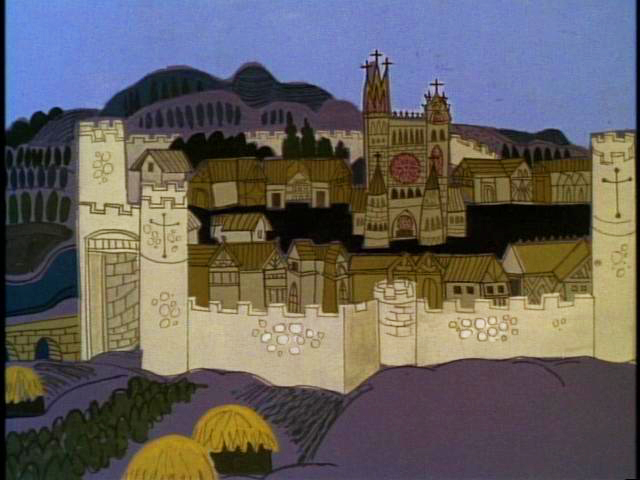
Color Styling in The Famous Adventures of Mr. Magoo
 |
| Paul Revere |
 |
| Treasure Island |
 |
| Gunga Din |
 |
| Moby Dick |
 |
| Treasure Island |
 |
| Cyrano de Bergerac |
Cyrano DeBergerac has a strong architectural component to it, featuring strong draftsmanship by Jacques Rupp, about whom you'll hear more in an upcoming post. Color palettes feature a diversity of looks, with some very clean palettes like the one at right along with some very dramatic palettes (see page 100 in my book.)
 |
| Noah's Ark |
The backgrounds by Bob Inman in Noah’s Ark are more traditional in painting technique but utilize unusual colors featuring hot pinks against cooler colors. This episode features nice design styling by Bob Singer.
 |
| King Arthur |
 |
| Robin Hood |
 |
| Doctor Frankenstein |
Monday, November 7, 2011
Magoo on TV DVD boxed set

A rundown of what’s in the box:


18 page illustrated booklet on Mr. Magoo’s TV career, including the
special, Mr. Magoo’s Christmas Carol.
And now for the inevitable questions:

Has this material been
re-mastered or restored? No, Shout
Factory was only able to use existing transfers. The expense of re-mastering from the original
negative is more than special interest releases like this can afford.
Have Mr. Magoo’s television commercials been included? Unfortunately, no. Most of them are difficult to find, some may
even be lost. There has been no archive
kept of any of his commercial work, including the hundreds of GE spots he made
over several decades. Once the material
is found, permission must then be obtained from often apathetic corporations for its
use.
Why wasn’t Mr. Magoo’s Christmas Carol included in the set?
Classic Media just released a new Blu-Ray transfer of the classic
special last year and preferred not to compete with itself by having it
included in this set.
The two highlights of this set for me are the documentary in
which some of the last remaining artists from UPA discuss the production of the
TV cartoons and the complete, never before released series,The Famous Adventures of Mr. Magoo. You can buy it here.

UPDATE! As a promotional giveaway, Shout Factory is offering a boxed set to the first one to correctly answer this question:
There were three credited actresses who provided the female voices for the Famous Adventures series but only one appeared only once. Who was she and in what episode did she provide the voice?
Thursday, November 3, 2011
David Weidman, painter

What ultimately became the book, Mr. Magoo’s Christmas Carol, The Making of the First Animated Christmas Special, started simply enough. Production Designer Michael Giaimo and I, who both had fond memories of the show, decided to interview David Weidman, one of the credited background painters on the special, to see what we could find out about the making of the film for ourselves, nothing more. After the recorder was setup and I pulled out my list of questions, I showed David stills from the film to tweak his memory and start the interview process. He stared and stared at the images and told me that not only didn’t he remember the film, he didn’t think he even worked on it.
 It was a bit disheartening to say the least, but after we began going through some of his artwork collection, the painting in the above photo surfaced making it clear that although he may not have remembered the film, he did indeed work on it. With a bit more interviewing, David began to recall painting a Christmas tree in the finale of the film but he only remembered it because he felt guilt over not painting it the same green as it was painted earlier in the film but instead chose a hue that he felt worked better for the environment. Because Weidman couldn’t answer any of my questions about the production, I began pursuing other leads and after several other interviews, it became apparent that there was a book waiting to be written on the making of the special.

What I did learn that day was that David Weidman was an incredibly prolific artist outside of his career in animation. David didn’t remember working on the film, not because of memory loss but because his mind was elsewhere at the time. Weidman had been classically trained as an artist and entered animation as a means to an end rather than an end in itself. His primary focus was on his own art, which he pursued after hours and between gigs at the studios.
 |
| Weidman in his early days |

He began his career in 1955 with John Hubley at Hubley’s Storyboard Studios working on commercials before assisting as a designer on the animated version of Finian’s Rainbow, which ultimately was never produced. David next found work at UPA as part of the hiring binge for The Boing Boing Show in 1956. He was one of several future Christmas Carol artists who found employment on the 1957 version of Crusader Rabbit and then spent time at TV Spots (later renamed Creston Studios) working on such sub-contracted productions as Jack Kinney’s 1960 Popeye TV shorts, King Leonardo and his Short Subjects, Jay Ward’s Fractured Fairy Tales and the wholly Creston-produced Calvin and the Colonel. In 1962, he was briefly back at UPA, helping to finish the background paintings for Mr. Magoo’s Christmas Carol. David is also credited as a background painter on The Famous Adventures of Mr. Magoo, which he did through Grantray Lawrence, who subcontracted a number of the episodes from UPA.


 Starting in the later 60s, designer Walt Peregoy took over as head of the background department at Hanna Barbera and began looking for people to shake up the look of the backgrounds. One of his first calls was to David Weidman, whom he felt shared his artistic aesthetic. Some of the series David painted on were Wacky Races and Dastardly and Muttley in Their Flying Machines. The two images from Wacky Races at right show how Weidman's serigraph work began to inform his background painting at the time. He returned to UPA as a freelancer in 1969 to work on Mr. Magoo’s last TV special, Uncle Sam Magoo.
Weidman has recently experienced a resurgence of interest in his prints, now deemed “Retro” although they were actually produced at the time and many of his prints are still available today. A book documenting his work and career was published and last year, Urban Outfitters produced a line of decorator pillows featuring his work. If you are interested in owning your own Weidman print or in buying a signed copy of his book, you can purchase both here. For those on a budget who would like to own both, I recommend buying the package that includes a signed copy of his book AND a miniature silk screen print of one of his designs.
 UPDATE! If you live in the Southern California area, David Weidman's works will be exhibited at Bermudez Projects in downtown Los Angeles starting November 11 through December 1st. David Weidman, Modern Master: Prints 1967-1974 is part of Pacific Standard Time, an initiative of the Getty
celebrating the birth of the LA art scene with over 60 cultural institutions
across Southern California. David anticipates being there for the VIP opening next Friday, November 11th from 6-9 PM. Please RSVP here if you plan to drop by to meet him in person and pick up one of his amazing prints. For more information, click here.
UPDATE! If you live in the Southern California area, David Weidman's works will be exhibited at Bermudez Projects in downtown Los Angeles starting November 11 through December 1st. David Weidman, Modern Master: Prints 1967-1974 is part of Pacific Standard Time, an initiative of the Getty
celebrating the birth of the LA art scene with over 60 cultural institutions
across Southern California. David anticipates being there for the VIP opening next Friday, November 11th from 6-9 PM. Please RSVP here if you plan to drop by to meet him in person and pick up one of his amazing prints. For more information, click here.


Monday, October 31, 2011
Happy Halloween!

Special thanks to Brian Peterson for the above image.
Subscribe to:
Posts (Atom)