

This week I profile Shirley Silvey, one of the unsung designers in animated cartoons. Besides contributing design work to Mr. Magoo’s Christmas Carol, Shirley had a key role as one of only two storyboard artists on the film. Her career in the medium lasted less than 20 years but during that short time frame, she was at the epicenter of TV animation in its heyday. Most of her career was spent at two shops, UPA and Jay Ward, and she shuttled back and forth between the two for many years. Born Shirley Jonas, both she and her older brother, David, worked as artists in the entertainment field; he became a production illustrator for live action, she went into animation.
 Shirley, like many others who worked on Mr. Magoo’s Christmas Carol, was hired as a designer straight out of art school for UPA’s The Boing Boing Show in 1956. Her first job there was for director Ed Levitt, designing the short The King and Joe. (Left, one of her concept paintings.) Unfortunately, the series failed to find either a sponsor or an audience and was soon canceled. After leaving UPA, she had a brief stint at Churchill-Wexler Film Productions, a producer of educational films.
Before long, Robert Dranko, famed UPA production designer, asked her to come back to UPA and join him on 1001 Arabian Nights, where she really began to blossom under his tutelage, assisting in storyboarding and designing both characters and backgrounds for the film. When asked about her contributions, Dranko still praised her work 50 years later.


Her assignment complete on 1001 Arabian Nights, Silvey next found employment at the Jay Ward studio, working on Rocky and His Friends and The Bullwinkle Show, again as a storyboard artist and designer. She joined Roy Morita, who had started slightly before her, and the two would split an entire season’s worth of shows to board and design, each doing an episode in just over three days (approx. 18 pages, six panels per page). If you've ever wondered why there are continuity issues from the end of one episode to the beginning of another, it's because Shirley and Roy were working simultaneously on back to back episodes in separate locations. (Below, one of her pages from the Wossamotta U adventure and Silvey's designs for Jay, Filcher and Belcher in the Rue Brittania adventure.)

 Shirley, like many others who worked on Mr. Magoo’s Christmas Carol, was hired as a designer straight out of art school for UPA’s The Boing Boing Show in 1956. Her first job there was for director Ed Levitt, designing the short The King and Joe. (Left, one of her concept paintings.) Unfortunately, the series failed to find either a sponsor or an audience and was soon canceled. After leaving UPA, she had a brief stint at Churchill-Wexler Film Productions, a producer of educational films.
 Before long, Robert Dranko, famed UPA production designer, asked her to come back to UPA and join him on 1001 Arabian Nights, where she really began to blossom under his tutelage, assisting in storyboarding and designing both characters and backgrounds for the film. When asked about her contributions, Dranko still praised her work 50 years later.


Her assignment complete on 1001 Arabian Nights, Silvey next found employment at the Jay Ward studio, working on Rocky and His Friends and The Bullwinkle Show, again as a storyboard artist and designer. She joined Roy Morita, who had started slightly before her, and the two would split an entire season’s worth of shows to board and design, each doing an episode in just over three days (approx. 18 pages, six panels per page). If you've ever wondered why there are continuity issues from the end of one episode to the beginning of another, it's because Shirley and Roy were working simultaneously on back to back episodes in separate locations. (Below, one of her pages from the Wossamotta U adventure and Silvey's designs for Jay, Filcher and Belcher in the Rue Brittania adventure.)

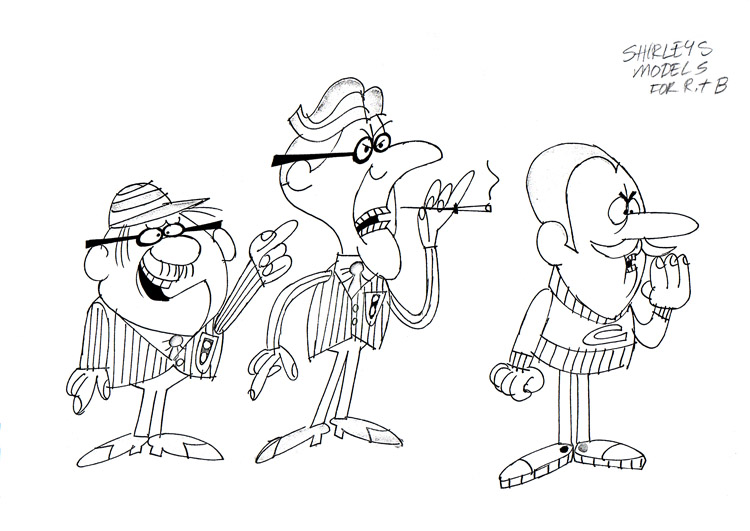
When boarding ceased, she pitched in doing layouts for other shows in the series, such as Peabody’s Improbable History and Aesop & Son and also served in the same capacities on the 1964 Jay Ward series, Hoppity Hooper. Shirley worked primarily from home, having been divorced from her first husband, so that she could raise her daughter. Working freelance necessitates working at a high rate of speed in order to keep the income at a reasonable level; apparently Silvey had no trouble keeping up as she was in constant demand and would jump from one job to another as each job finished. (Below, Silvey's layout drawing for the Rocky & Friends end credits and some of her character designs for an episode of Aesop & Son)


As mentioned in the book, she rejoined UPA to work on Mr. Magoo’s Christmas Carol doing storyboards and layouts during a hiatus at Ward’s. When called back to Ward, Bob Singer finished the character layouts for her sequence (the appearance of Jacob Marley). Some of the sequences she remembered boarding were the prologue, the Cratchit household with the" Lord’s Bright Blessing" song, the Despicables and the deleted sequences with Fan at young Scrooge’s school and at nephew Fred’s house at the end of the original story.


She occasionally did freelance work for UPA in later years; one of her assignments was creating faux "production stills" to help sell The Famous Adventures of Mr. Magoo. She also freelanced on The Roadrunner Show for Depatie Freleng, who had taken over Looney Tunes production from the defunct Warner Bros. Cartoons division. Abe Levitow asked her to join him at MGM Visual Arts to storyboard on How the Grinch Stole Christmas but she was unable to do so due to commitments at Ward. (Below, Silvey's original layout from The Count of Monte Cristo pitch art and the still created from it. The final character designs bear little resemblance to this preliminary piece.)


Between series’ work at Jay Ward, she would board and layout Cap’n Crunch commercials. When George of the Jungle came along, Shirley was responsible for laying out the title sequence and also contributed her skills to both the George and Super Chicken segments of the show.

Shirley remarried (and changed her name to Berg) and was able to work in-house in her later years at Ward, where she shared a room with good friend Gloria Wood, key background painter on Mr. Magoo’s Christmas Carol. During this period, she conceived and pitched a show called Space Granny for which Bill Scott wrote the pilot and she did the boards; unfortunately it was never produced. Scott named one of the two children Silvey (misspelled in the boards) in Shirley's honor.

When Ward experienced difficulty selling any more new shows to the networks in the 1970s, the studio devoted most of their efforts to Cap’n Crunch spots. Shirley herself left animation in 1973 (coincidentally, the same year Christmas Carol alum Bob Inman left the business). She had just spent a particularly grueling gig at Depatie Freleng on the ABC After School Special, The Magical Mystery Trip Through Little Red’s Head. As her daughter, Beckie, recounts:
In 1973, work at Jay’s was scarce. She told me she didn't like the direction cartoons were going in. She didn't like drawing them and didn't think they were funny. She said she later regretted the decision to retire but by that time it was too late to re-enter the animation industry. She didn't elaborate further, so I have no idea why she felt that way. She did begin painting again and took up stained glass but by the late 1970's she had become very ill with severe chemical sensitivities and had to give that up because of the chemicals in the paints. She was really very ill from that point on until the end of her life. She was able to sketch and learned watercolors so she could keep going with her art. One day in the early 1980's she thought she had to find something she could laugh about because her life was so grim, so she began drawing Elliot ( a comic strip) for the next 20 years, and later the Bad Hare (for a series of greeting cards).

Shirley Silvey Berg passed away July 17, 2010 of heart failure. Her final request was to be buried holding one of her ubiquitous Rapidograph pens in drawing position.


As mentioned in the book, she rejoined UPA to work on Mr. Magoo’s Christmas Carol doing storyboards and layouts during a hiatus at Ward’s. When called back to Ward, Bob Singer finished the character layouts for her sequence (the appearance of Jacob Marley). Some of the sequences she remembered boarding were the prologue, the Cratchit household with the" Lord’s Bright Blessing" song, the Despicables and the deleted sequences with Fan at young Scrooge’s school and at nephew Fred’s house at the end of the original story.


She occasionally did freelance work for UPA in later years; one of her assignments was creating faux "production stills" to help sell The Famous Adventures of Mr. Magoo. She also freelanced on The Roadrunner Show for Depatie Freleng, who had taken over Looney Tunes production from the defunct Warner Bros. Cartoons division. Abe Levitow asked her to join him at MGM Visual Arts to storyboard on How the Grinch Stole Christmas but she was unable to do so due to commitments at Ward. (Below, Silvey's original layout from The Count of Monte Cristo pitch art and the still created from it. The final character designs bear little resemblance to this preliminary piece.)


Between series’ work at Jay Ward, she would board and layout Cap’n Crunch commercials. When George of the Jungle came along, Shirley was responsible for laying out the title sequence and also contributed her skills to both the George and Super Chicken segments of the show.

Shirley remarried (and changed her name to Berg) and was able to work in-house in her later years at Ward, where she shared a room with good friend Gloria Wood, key background painter on Mr. Magoo’s Christmas Carol. During this period, she conceived and pitched a show called Space Granny for which Bill Scott wrote the pilot and she did the boards; unfortunately it was never produced. Scott named one of the two children Silvey (misspelled in the boards) in Shirley's honor.

When Ward experienced difficulty selling any more new shows to the networks in the 1970s, the studio devoted most of their efforts to Cap’n Crunch spots. Shirley herself left animation in 1973 (coincidentally, the same year Christmas Carol alum Bob Inman left the business). She had just spent a particularly grueling gig at Depatie Freleng on the ABC After School Special, The Magical Mystery Trip Through Little Red’s Head. As her daughter, Beckie, recounts:
In 1973, work at Jay’s was scarce. She told me she didn't like the direction cartoons were going in. She didn't like drawing them and didn't think they were funny. She said she later regretted the decision to retire but by that time it was too late to re-enter the animation industry. She didn't elaborate further, so I have no idea why she felt that way. She did begin painting again and took up stained glass but by the late 1970's she had become very ill with severe chemical sensitivities and had to give that up because of the chemicals in the paints. She was really very ill from that point on until the end of her life. She was able to sketch and learned watercolors so she could keep going with her art. One day in the early 1980's she thought she had to find something she could laugh about because her life was so grim, so she began drawing Elliot ( a comic strip) for the next 20 years, and later the Bad Hare (for a series of greeting cards).

Shirley Silvey Berg passed away July 17, 2010 of heart failure. Her final request was to be buried holding one of her ubiquitous Rapidograph pens in drawing position.


 shorts,
  (produced by Lee Orgel and scored by
  , also veterans of Mr. Magoo’s Christmas Carol).


